
GAFAM NewsEssay
When will AGI arrive, and will it make us happy? 30 answers on one map
I plotted 30 AI voices, 15 abroad and 15 in Japan, by AGI timing and optimism: what the map shows, what it hides, and Japan's different kind of worry.
- First published in Japanese
- English edition
In August 2026, Demis Hassabis, the Nobel laureate in chemistry, stepped down as CEO of Google DeepMind. Not to retire, but to focus on AGI (artificial general intelligence). His memo to staff reportedly said that AGI is close at hand and that getting the next steps right matters enormously for humanity. [1]
When will AGI arrive? And when it does, will it make us happy?
Opinions on this now cross my path almost every day. One person says “one or two more years.” Another says “still a long way off.” Another says “the question itself is framed wrong.”
There are so many voices, pointing in so many directions, that I decided to sit down and sort them out properly.
The sorting tool is simple. Plot people on two axes: “optimistic or pessimistic,” and “when do they expect AGI to arrive?” My hypothesis was that this would reveal the real issues and the real lines of disagreement. Let’s test it.
I picked 30 people seen as having a big voice in the AI world, 15 outside Japan and 15 in Japan, collected their statements, essays and interviews from 2024 to 2026, and laid them out on these two axes.
Before we start: what this map can and can’t show
Before I show you the map, two caveats.
First, I placed each person on this plot with the help of AI, by applying a scoring rubric to their public statements.
Of the 30, only 10 state a timeline for AGI in their own words. For the other 20, with no explicit statement, I estimated the position from other things they have said (these are the hollow ○ marks on the map). Where someone’s view has shifted over time, I gave priority to their most recent statements and summarized them as a single point.
Boiling a person’s thinking down to a single coordinate means simplifying a great deal. What you get in exchange is a picture that lets you take in the whole debate among 30 people at a glance. That is the trade-off this map makes.
The scoring rubric and the evidence for each person are at the end of the article, so if you check them and think “that position is wrong,” I welcome it.
Second, because of that simplification, there are inevitably things this map cannot express.
Two people sitting side by side may have arrived there by completely different routes. Two people who are both “pessimistic” may fear exact opposites.
So, quadrant by quadrant, I’ll write separately about “what became visible once I drew the map” and “differences within the same quadrant that the map can’t show.”
That distinction may be the most important part of this article.
The map: how the 30 are distributed
Reading the map is simple.
The horizontal axis is “when do they expect AGI to arrive?” The further right, the more “imminent, or already here.” The further left, the more “still far off, or never coming at all.”
The vertical axis is “what do they expect to happen when it arrives?” Up is optimistic, down is pessimistic.
Blue is outside Japan, orange is Japan. A filled ● means the person stated a timeline themselves, a hollow ○ means no explicit statement and an estimate based on what they have said, and ✕ means the person rejects the very framing of the AGI question.
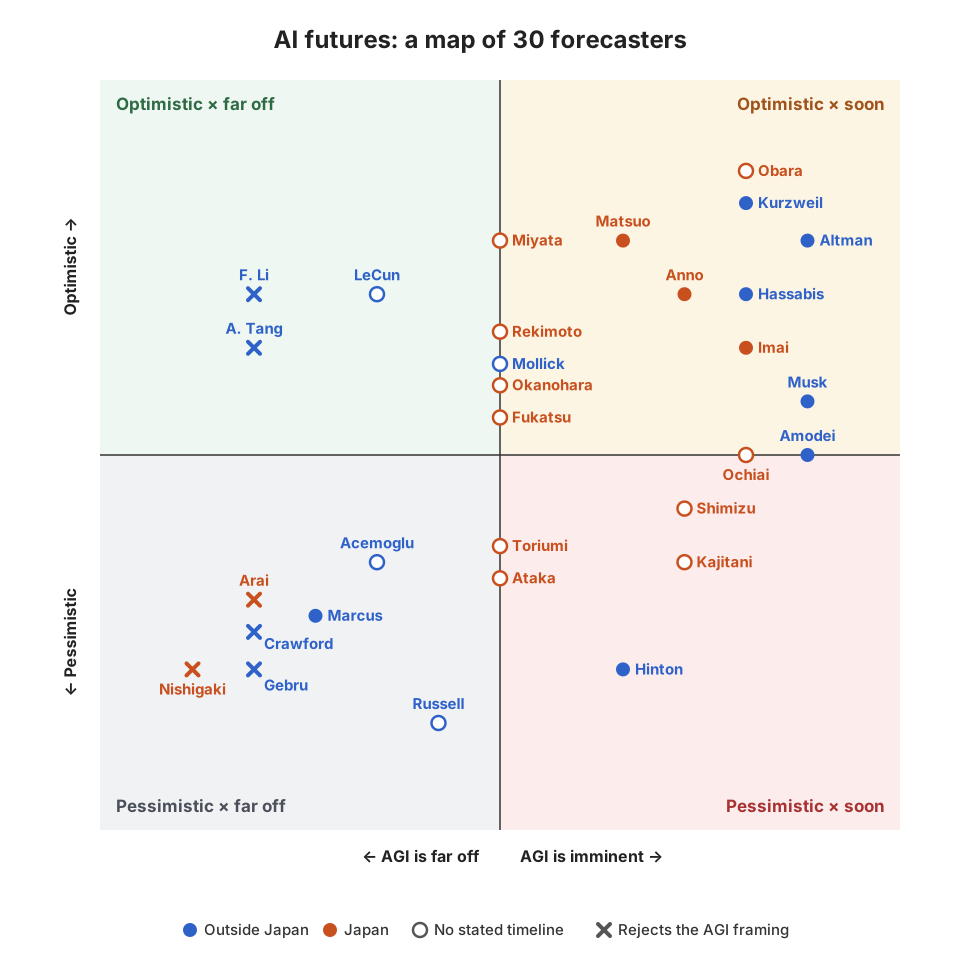
AI futures: a map of 30 forecasters (scored from primary sources dated 2024 to 2026; see the appendix at the end for the method).
The first things you notice, looking at the whole, are that the points are heavily skewed toward the upper right, and that a column of points lines up directly on the vertical axis.
Upper right, “optimistic × soon”: the most crowded zone
What the map revealed is a skew: this quadrant is the largest bloc among the 30.
Altman, Kurzweil, Musk, Demis Hassabis and most of the Japanese contingent gather here.
Until the first half of 2025, Hassabis was saying “5 to 10 years” [2], but in May 2026 he shortened that to “2029 to 2030” [3]. He offers a concrete picture of the benefits, as when he says of ending disease, “I think that’s within reach. Maybe within the next decade or so, I don’t see why not.” That makes him one of the more substantive voices in this quadrant.
The Japanese commentators are concentrated here too. Yutaka Matsuo states plainly, “three years at the earliest, ten at the latest” [4], and talks about AGI as an industrial opportunity that Japan “must use.” [5]
Takahiro Anno takes AGI arriving around 2028 as a given, and connects it to the practical question of how to implement it in politics: digital transformation of elections and the Diet. [6]
Shota Imai says that “general-purpose artificial intelligence will be realized within the next few years,” also cites an estimate that “80% of all occupations will be affected,” and still concludes that “people’s lives are clearly going to get better from here.” [7]
At the very top of this quadrant sits Kazuhiro Obara, whose optimism stands out even among the 30. He talks about AI through an analogy: the arrival of photography turned portrait painters into artists and gave birth to a larger art industry. [8]
On the other hand, there are two differences the map can’t show.
One is how each person moves their forecast. On the map, Musk, Altman and Kurzweil are practically neighbors, but each of them got to that point by a different route.
Musk is the type whose year slides back roughly one year every year. In 2025 he said it would come by the end of 2025, and at Davos in January 2026 he said that within the next two or three years AI would surpass humans at almost every cognitive task. [9]
Altman is the type who moves the definition rather than the year. In September 2024 he wrote that we may have superintelligence “in a few thousand days” [10]; in June 2025 he declared, “We are past the event horizon” [11]; and in December 2025 he said that AGI might already have gone whooshing by, and that the next thing is ASI (superintelligence). [12]
And Kurzweil has not moved “AGI in 2029, the singularity in 2045” one inch in 27 years, since 1999. [13] A forecast that never moves, a forecast whose year keeps sliding, and a forecast where the definition of the goal itself moves. In a still image they are the same single point, but the weight of trust a reader should place in each is not the same.
The other difference is what the optimism is based on.
Kurzweil’s optimism comes from a philosophy of humans merging with AI, Hassabis’s from a track record of applying AI to science (drug discovery, materials), and Matsuo’s from industrial opportunity for Japan.
Same quadrant, different bets.
Lower right, “pessimistic × soon”: few people, divided substance
What the map revealed here is the contrast with the upper right.
Only three people land in this quadrant: Hinton, Ryo Shimizu and Kento Kajitani.
And Anthropic CEO Dario Amodei, often talked about as the archetype of “pessimistic × soon,” actually sits not inside the quadrant but on the boundary line where the vertical score is zero.
Hinton has held to a range of 5 to 20 years and a 10 to 20% probability of human extinction for several years. [14] Lately, though, the center of gravity of what he says has moved from existential risk to jobs. In his words: “It’s going to create massive unemployment and a huge rise in profits. It will make a few people much richer and most people poorer. That’s not AI’s fault, that is the capitalist system.” [15]
Amodei is the only one of the 30 to put optimism and pessimism on the same scale with numbers: “There’s a 25% chance that things go really, really badly,” and a 75% chance that things go really well. [16] He says powerful AI could arrive in as little as one to two years, the shortest timeline among the 30. [17]
The Japanese commentators who fall in this quadrant on the map are Ryo Shimizu and Kento Kajitani. Shimizu holds that “AI has crossed the threshold,” meaning the turning point has already passed. He writes that white-collar jobs will vanish in five areas, from management decisions to accounting, and warns that “there is no longer any sanctuary.” [18]
But here too there is a difference the map can’t show.
Within the same “pessimistic × soon,” Hinton’s and Amodei’s pessimism is about AI becoming too powerful, while Shimizu’s writing is less a prophecy of doom than a kind of realism about how to respond to a structural change that has already happened. He is not squarely arguing about existential risk to humanity.
What’s more, Hinton’s single point is also a still image. Over these three years the center of gravity of his pessimism has moved from existential risk to jobs and inequality. The point stays in the same place, but what is inside it is moving.
Lower left, “pessimistic × far off”: the people worried because AI is weak
At first glance this quadrant looks contradictory. If it isn’t coming yet, why be pessimistic?
Marcus’s answer is this: AGI won’t arrive in 2025, 2026 or 2027, and yet the whole economy is being rebuilt on the assumption that it will. [19]
Daron Acemoglu, the Nobel laureate in economics, estimates in a peer-reviewed paper that the productivity gain from AI will be no more than 0.66% over the next 10 years, and predicts widening inequality. [20]
Stuart Russell refuses to predict a number of years at all, yet issues the strongest warning among the 30: that governments are letting private companies play Russian roulette with all of humanity. [21]
What the map revealed is that there are two kinds of pessimism.
If the pessimism in the lower right is about AI that is too strong, the pessimism in this quadrant is about AI that is weak but over-trusted, or about capital and power that move using AI as their pretext. This difference in quality showed up on the map precisely because I added the horizontal axis.
But inside this quadrant, too, there are differences the map can’t fully separate. Marcus and Acemoglu stand on the left as a forecast: “AGI isn’t coming for a while.”
Noriko Arai (generative AI is “a machine for mass-producing work that doesn’t need doing” [22]) and Toru Nishigaki (the singularity hypothesis “lacks scientific grounding” [23]), on the other hand, are not making a forecast at all. They reject the very framing of the question of when AGI will arrive. The map just barely tells them apart with the ✕ mark, but “people who forecast it won’t come” and “people who refuse the question” may share coordinates, but they hold different positions.
Upper left, “optimistic × far off”: hard on the technology, easy on the risk
Yann LeCun is thoroughly skeptical of the technology, saying that human-level intelligence will not come from extending LLMs [24], yet he brushes off doom talk and is optimistic about the outcome: AI, he says, will amplify human intelligence. [25]
Fei-Fei Li (who has called AGI a marketing term [26]) and Audrey Tang (who says superintelligence is on the side of us, the people [27]) belong to the same group: they shift the AGI question itself while affirming the technology’s benefits.
The people standing on the center line
One more thing. Can you see Japanese commentators lined up vertically near the middle of the map, around zero on the horizontal axis?
Hiroaki Miyata, Jun Rekimoto, Daisuke Okanohara and Takayuki Fukatsu. Add Ethan Mollick from outside Japan.
What they have in common is that they deliberately don’t talk about when AGI will arrive.
Mollick says outright that he doesn’t make predictions and that we should prepare for multiple futures; instead of a forecast, he offers numbers from a field experiment with 776 people. [28]
Rekimoto replaces “will AI surpass humans?” with “how will AI and humans be integrated?”, and titled his final lecture exactly that: “Toward the era of Human–AI Integration.” [29]
Okanohara acknowledges that the technology is accelerating, but avoids committing to a timeline because of physical constraints: electric power and the capacity to verify. [30]
I didn’t put these people at zero on the horizontal axis because their views are “in the middle.” It’s because the map can only put “withholding judgment” and “considering it neutral” in the same place.
Not talking about timing is not the absence of a position. It is a position of its own: keeping a distance from the question of “when will it come?”
Making the map also showed me that this “third group” is especially strong in Japan.
From here on, analysis: what does Japan’s “empty lower right” mean?
From here, I’ll add interpretation to the distribution we’ve looked at. The sorting of facts ends here; what follows is hypothesis.
Look at the map again.
I’m not saying the lower right is empty. Shimizu and Kajitani are there.
But among the 15 Japanese commentators, I could not find a single one whose main issue is “existential risk to humanity from AI,” the issue that symbolizes the Western “it’s coming soon, and it’s dangerous.”
What’s empty is not the quadrant itself but the content of the pessimism.
The line of argument that superhuman intelligence is coming soon and will bring catastrophic results: is it rare in Japan? What’s your sense of it?
Before leaping straight from this “gap” to a theory about Japan, though, there are two points to stop and consider.
The first is the small sample.
There are only 15 people on the Japanese side. And these 15 were chosen by me and AI using the criterion “well known, with enough recent statements to work from.” Choose differently and the map could look different.
Japanese researchers who discuss military uses of AI and existential risk do exist outside the list of well-known names. What this map can show is a tendency with a qualifier attached: “at the center of Japan’s mainstream AI discourse.”
The second is that this position is hard to take in the first place.
Look at who is issuing head-on warnings about existential risk. Hinton is a father of deep learning, Amodei is CEO of a frontier AI company, and Russell wrote the AI textbook. (Their positions on the map split into the lower right, the boundary line and the lower left, but their warnings belong to the same lineage.)
In other words, the claim “it’s coming soon, and it’s dangerous” is a position you can state with credibility precisely because you are an insider who has built the technology at the front line. “What I built is dangerous” carries a completely different weight from an outsider’s “I hear that thing is dangerous.”
As long as frontier model development is concentrated in the United States, the near-absence of people in Japan with standing to say this reflects the geography of development more than the maturity of the discourse.
I think it’s closer to reality to read the gap not as “Japanese people are insensitive to risk” but as “the structure simply hasn’t produced people in a position to issue that warning.”
Even so, a difference remains. It’s not that Japan has no cautionary voices. They take a different shape.
Kazuto Ataka’s argument is emblematic. What he fears is not AI running out of control, but AI succeeding. “What’s frightening is judgments that are well-meaning, logical, correct by the data and impossible to argue with, quietly becoming fixed in society.” [31]
Kento Kajitani, after his practical optimism in 2024, turned around and wrote in 2026: “Since AI can produce the right answer instantly, the market value of intelligence also approaches zero. Meritocracy will collapse.” [32]
Takayuki Fukatsu is pessimistic in the short term (“bullshit jobs will increase explosively in one to three years”) and optimistic in the long term (“an era will come when humanity can just play”). [33]
Some stand on the boundary line. Yoichi Ochiai gives one of the fastest timelines among the 30, saying “most intellectual work will be replaced by AI by early 2026” [34], and in the same breath talks about both hopes for abundance and concerns about war, division and a lower bar for misuse. On the map I placed him at plus on the horizontal axis and zero on the vertical, on the boundary between the upper right and the lower right. I think that refusal to be filed as either optimist or pessimist is itself the shape of his argument.
In other words, Japan’s cautionary voices are aimed not at “will AI destroy humanity?” but at “how will AI quietly rewrite society’s decision-making and the value of labor?”
Fujio Toriumi’s concern, too, is not AI itself running amok but misinformation and the attention economy eating away at human judgment. In his words, “information health.” [35]
So even after discounting selection bias and the uneven standing to speak, what remains is a difference in how the question is framed: “Japan’s cautionary voices are aimed not at existential risk but at the quiet rewriting of society.” I think this should be called not a gap but a different lineage of caution.
Conclusion: when will AGI arrive, and will it make us happy?
Back to the two questions at the start.
When will AGI arrive?
What lining up the 30 taught me was less the answer itself than how widely the answers are scattered. From “it’s already here” to “it’s never coming,” there are not many questions on which people at the front line are this divided.
When it arrives, will it make us happy?
This too is divided. But not into “optimists versus pessimists.” What people fear, and what they are betting on, differs from person to person.
Hinton’s pessimism and Marcus’s pessimism are different things, and so are LeCun’s optimism and Altman’s optimism. And Japan’s cautionary voices were aimed not at existential risk but at the quiet rewriting of society.
So my opening hypothesis, that lining people up on two axes would reveal the lines of disagreement, worked to a degree.
Even with two axes, though, the map can’t capture the history of a forecast or the quality of a pessimism.
The map is an entrance to the debate, not its conclusion. That is why I kept insisting, throughout this article, on separating “what the map showed” from “what it doesn’t.”
There are three variables to watch on this map from here.
Whether forecast years move again, starting with Hassabis, who stepped away from running DeepMind to pursue AGI (especially Amodei’s “one to two years” and Hassabis’s “2029 to 2030”).
Whether any of the Japanese commentators concentrated in the upper right move to the lower right.
And whether the day comes when the arguments of the ✕ people, who reject the AGI question itself, somehow mesh with the arguments about timelines.
Whose forecast will come true, I can’t tell. I’m just an owl 🦉.
But the next time you see a voice saying “AGI is coming soon” or “AI will destroy humanity,” stop for a moment and ask where on the map it sits, and whose voice it is. I’d be glad if this map gave you a foothold for that.
Appendix
How the scores were assigned
The subjects are 30 people: 15 outside Japan and 15 in Japan. For each person I collected 3 to 9 sources (their own essays and blog posts, peer-reviewed papers, government and advisory council materials, interviews, lecture transcripts, YouTube and podcasts), and as a rule gave priority to recent statements from 2024 to 2026.
Positions were determined not by automatic classification with embedding vectors but by scoring against a written rubric. The scoring used AI (Claude). With vector similarity, a human can’t verify “why is this person here?”, so I chose a method in which each score is tied to one supporting quote. My judgment is that the claim “using embeddings makes it objective” doesn’t hold for this kind of analysis.
-
Horizontal axis (AGI arrival timing): +5 = already reached to 1–2 years / +4 = 3–4 years / +2 = 5–10 years / 0 = doesn’t talk about timing / −2 = won’t be reached by extending current technology / −4 or below = rejects the AGI framework itself
-
Vertical axis (assessment of the outcome): +5 = predicts decisive benefits / 0 = presents both benefits and harms / −5 = predicts existential danger
On the map, ● marks people who stated a timeline themselves (10 of the 30), ○ marks people with no explicit statement whose position was estimated from other statements, and ✕ marks people who reject the very framing of the AGI question. Erasing this distinction would turn “things they didn’t say” into “things they said,” so I kept it on the map.
Limitations
-
The scores went through a rubric interpretation using AI (Claude). Other readings that give a different score from the same quote are possible. The supplementary table includes the evidence for everyone, so you can verify and rescore from there.
-
As a limit of a method that relies on AI assistance, I did not read every one of the more than 120 sources I collected in detail, and a complete human fact check was not possible. The AI checked quotes and URLs against the sources when retrieving them, but errors may remain. Please point out anything you notice.
-
Some primary sources could not be retrieved because of paywalls or robots.txt (for example, Daisuke Okanohara’s Nikkei Robotics column series “From AGI to ASI”).
-
The six ✕ people (Gebru, Crawford, F. Li, A. Tang, Arai, Nishigaki) are really “outside the axes.” Placing them at the left edge is a plotting convenience, and it has the limitation of making “people withholding an answer” and “people rejecting the question itself” hard to tell apart on the map.
-
The selection of subjects is itself biased. In particular, the 15 on the Japanese side were chosen by “prominence” and “richness of recent primary sources,” and are not a random sample of Japanese AI discourse. The discussion of the “empty lower-right quadrant” in the main text rests on this limitation.
-
This is a snapshot as of August 2026. Forecast years move. This map should look different by next year.
Supplementary table: scores and a summary of the evidence for all 30
| Person | X | Y | Basis for X (AGI arrival timing) | Basis for Y (assessment of the outcome) |
|---|---|---|---|---|
| G. Hinton | 2 | -4 | 5–20 years / June 2026: within 20 years | Extinction probability of 10–20%; explicitly predicts mass unemployment and widening inequality |
| Y. LeCun | -2 | 3 | Not stated. Definitely not within a few years / conceptual breakthroughs needed | Dismisses existential-risk arguments and also rejects job-loss arguments. But technically pessimistic about LLMs |
| D. Hassabis | 4 | 3 | 2029–2030 (shortened in May 2026) | Eradicating disease, radical abundance. But anxious that safety is lagging |
| D. Amodei | 5 | 0 | 1–2 years to powerful AI (June 2026) | Quantifies it himself: 25% worst case / 75% best case. Strong warnings on jobs |
| Fei-Fei Li | -4 | 3 | AGI is a marketing term, not a scientific term | “Technology is net positive,” on the condition that it depends on people |
| G. Marcus | -3 | -3 | Not in 2025–2027, nor in this decade / possible within this century | Trillion-dollar bets, a bubble, misinformation. Pessimistic because AI is weak |
| T. Gebru | -4 | -4 | Undefined AGI cannot be safety-tested (peer-reviewed paper) | Holds that labor exploitation, bias and environmental costs are already happening |
| K. Crawford | -4 | -3 | Skeptical of the very concept of intelligence (statistical probability at scale) | Environment, labor, surveillance. Calls herself a technology realist |
| S. Russell | -1 | -5 | Refuses to predict a number of years. Arrival is virtually certain, but “longer” | Russian roulette with all of humanity; 80% unemployment |
| E. Mollick | 0 | 2 | Deliberately refuses to predict: prepare for multiple futures | P&G experiment with 776 people: 0.37 SD improvement, 12–16% time saved |
| D. Acemoglu | -2 | -2 | Truly huge gains require AGI-level AI = not within 10 years | TFP 0.66% or less over 10 years; widening gap between capital and labor |
| A. Tang | -4 | 2 | Rejects the singularity framing (“plurality is here”) | Optimism conditional on design. Warns against conformity to optimization |
| E. Musk | 5 | 1 | End of 2026 to 2027 (Davos, January 2026) | Admits a 10–20% extinction probability yet calls it positive expected value. Talks of abundance in 2026 |
| S. Altman | 5 | 4 | AGI already passed; the issue is now ASI (December 2025 to April 2026) | Gentle singularity / massive prosperity; concerned about concentration of power |
| R. Kurzweil | 4 | 5 | AGI in 2029 / singularity in 2045 (unchanged since 1999) | Fusion of humans and AI. The strongest optimism of the 35. Only reservation is jobs |
| Y. Matsuo | 2 | 4 | 3 years at the earliest, 10 at the latest (Nikkei expert survey, June 2025) | Economic growth and industrial competitiveness. A norm: “we must use it” |
| T. Fukatsu | 0 | 1 | Not stated. A stage-by-stage view in units of years | Pessimistic in the short term (more bullshit jobs), optimistic in the long term |
| Y. Ochiai | 4 | 0 | “By early 2026 intellectual work will be almost entirely replaced” / on PIVOT: “AGI within a year” | Optimism about acceleration coexists with pessimism about war, division and a lower bar for misuse |
| N. Arai | -4 | -3 | Keeps her distance from AGI talk. Argues on the premise that AI “doesn’t understand meaning” | “A machine for mass-producing work that doesn’t need doing,” “a husband you can’t divorce” |
| D. Okanohara | 0 | 1 | Not stated (“the next 5 years, 10 years,” said in 2024) | Accepts acceleration but withholds judgment on social outcomes. Sees power and verification capacity as constraints |
| T. Anno | 3 | 3 | Assumes AGI arrives around 2028 | Change is an opportunity. AI making democracy two-way |
| J. Rekimoto | 0 | 2 | Not stated. An engineer’s time frame of “the next 10 years” | Human–AI Integration. Preserving self-efficacy over efficiency |
| R. Shimizu | 3 | -1 | “AI has crossed the threshold” = the turning point has already passed | “No sanctuary” from the disappearance of white-collar work. But realism |
| K. Ataka | 0 | -2 | Doesn’t talk about timing. Assumes “an era in which AI is fully deployed” | “If AI succeeds too much, society breaks.” Japan’s competitiveness “crushingly defeated” |
| F. Toriumi | 0 | -2 | Not stated | Misinformation, polarization, attention economy. Proposes “information health” |
| H. Miyata | 0 | 4 | Not stated (no reference to AGI or the singularity found) | “Think from the future, not as an extension of regulation.” Among the strong promoters even of the 35 |
| T. Nishigaki | -5 | -4 | The singularity hypothesis “isn’t worth examining seriously” | Suppression of freedom in the name of efficiency; suppression of the body and emotion |
| K. Obara | 4 | 5 | No forecast of his own, but uses “AGI around 2030” as a working premise | Analogy of photography and the Impressionists. The strongest optimism even of the 35; does not take up job losses as an issue |
| K. Kajitani | 3 | -2 | Introduces and endorses “superintelligence by the end of the 2020s is a realistic scenario” | Turned pessimistic in 2026. “Meritocracy will collapse,” “optimism is an illusion” |
| S. Imai | 4 | 2 | “Within the next few years” (December 2025) / adopts the average of others’ forecasts, 2030 | 80% of occupations affected; in 20%, more than half replaced. Even so, “life will get better” |
Citations and references
These correspond to the [numbers] in the text. Only URLs that were actually retrieved and checked are listed. Last accessed: August 21, 2026.
[1] Demis Hassabis steps down from Google DeepMind CEO role amid a major AI leadership shake-up (Fortune), August 5, 2026 — https://fortune.com/2026/08/05/demis-hassabis-steps-down-google-deepmind-ai-shakeup/
[2] AI could end disease, lead to “radical abundance” (CBS News 60 Minutes transcript), April 20, 2025 — https://www.cbsnews.com/news/artificial-intelligence-google-deepmind-ceo-demis-hassabis-60-minutes-transcript/
[3] Google DeepMind CEO Demis Hassabis says we’re close to AGI (Axios), May 26, 2026 — https://www.axios.com/2026/05/26/deepmind-ceo-demis-hassabis
[4] When will superintelligence arrive? Analyzing the views of 26 experts (Nikkei visual data) (in Japanese), June 9, 2025 — https://vdata.nikkei.com/newsgraphics/agi-timeline/
[5] “AGI will arrive”: what Professor Yutaka Matsuo really meant (Business Insider Japan) (in Japanese), April 30, 2026 — https://www.businessinsider.jp/article/2604-prof-matsuo-agi-100-startups-mission/
[6] [Prepare for “AGI’s arrival” in 2028] The US–China AI war: how can Japan win? (Rakumachi Channel, summary) (in Japanese), May 7, 2026 — https://blog.path-finder.jp/general/2028年agi到来に備えよ米中ai戦争日本の勝ち筋はチーム/
[7] The future of HR that AI brings: lecture record of Shota Imai (Japan Productivity Center) (in Japanese), December 2025 — https://www.jpc-net.jp/column/detail/dhrclub_humancapital34.html
[8] AI will bring a “super-language revolution”: Kazuhiro Obara’s 10-year forecast from 2026 (Sendenkaigi AdverTimes) (in Japanese), January 7, 2026 — https://www.advertimes.com/20260107/article530458/
[9] Musk speaks at WEF Davos 2026 (Rev transcript), January 25, 2026 — https://www.rev.com/transcripts/musk-speaks-at-wef
[10] The Intelligence Age (Sam Altman’s own blog), September 23, 2024 — https://ia.samaltman.com/
[11] The Gentle Singularity (Sam Altman’s own blog), June 10, 2025 — https://blog.samaltman.com/the-gentle-singularity
[12] Altman claims ‘AGI’ might have already “whooshed by” (Windows Central), December 24, 2025 — https://www.windowscentral.com/artificial-intelligence/openai-ceo-sam-altman-claims-agi-might-have-already-whooshed-by
[13] Why Kurzweil still sees AGI coming by 2029 (The Deep View), April 13, 2026 — https://www.thedeepview.com/articles/why-kurzweil-still-sees-agi-coming-by-2029
[14] The ‘godfather of AI’ reveals the only way humanity can survive superintelligent AI (CNN), August 13, 2025 — https://www.cnn.com/2025/08/13/tech/ai-geoffrey-hinton
[15] Geoffrey Hinton says AI will cause massive unemployment (Fortune), January 12, 2026 — https://fortune.com/article/godfather-ai-geoffrey-hinton-massive-unemployment-soaring-profits-capitalism-hyperscalers/
[16] Amodei on AI: “There’s a 25% chance that things go really, really badly” (Axios), September 17, 2025 — https://www.axios.com/2025/09/17/anthropic-dario-amodei-p-doom-25-percent
[17] The Adolescence of Technology (Dario Amodei’s own essay), January 2026 — https://darioamodei.com/essay/the-adolescence-of-technology
[18] Five white-collar jobs that generative AI will “eliminate”… there is no longer any sanctuary (Ryo Shimizu, Business Insider Japan) (in Japanese), June 16, 2025 — https://www.businessinsider.jp/article/2506will-genai-eliminate-white-collar-jobs/
[19] Six (or seven) predictions for AI 2026 (Gary Marcus, Marcus on AI), December 20, 2025 — https://garymarcus.substack.com/p/six-or-seven-predictions-for-ai-2026
[20] Acemoglu, “The Simple Macroeconomics of AI,” Economic Policy 40(121), 2025 — https://academic.oup.com/economicpolicy/article-abstract/40/121/13/7728473
[21] Stuart Russell Says AI Could Turn Humans ‘Into Less Than A Human Being’ (AFP / AI Impact Summit), February 19, 2026 — https://www.sahmcapital.com/news/content/stuart-russell-says-ai-could-turn-humans-into-less-than-a-human-being-urges-action-on-super-intelligent-systems-2026-02-19
[22] Generative AI is “a husband you can’t divorce”: interview with Noriko Arai (Recruit Works Institute) (in Japanese), July 14, 2026 — https://www.works-i.com/research/project/bullshit/fight/detail010.html
[23] What are GAFA’s political ambitions lurking behind the “singularity”? Commentary on The Delusive AI Myth (Hayakawa Publishing) (in Japanese), July 19, 2019 — https://www.hayakawabooks.com/n/nd3281b5237c3
[24] Yann LeCun’s new venture is a contrarian bet against LLMs (MIT Technology Review), January 22, 2026 — https://www.technologyreview.com/2026/01/22/1131661/yann-lecuns-new-venture-ami-labs/
[25] AI Impact Summit 2026: LeCun says AI will be an amplifier for human intelligence (Storyboard18), February 19, 2026 — https://www.storyboard18.com/brand-makers/ai-impact-summit-2026-ex-meta-ai-scientist-yann-lecun-says-says-ai-will-be-an-amplifier-for-human-intelligence-90108.htm
[26] Even the Godmother of AI has no idea what AGI is (TechCrunch), October 3, 2024 — https://techcrunch.com/2024/10/03/even-the-godmother-of-ai-has-no-idea-what-agi-is
[27] Plurality & 6pack.care (Audrey Tang, LessWrong), September 1, 2025 — https://www.lesswrong.com/posts/anoK4akwe8PKjtzkL/plurality-and-6pack-care
[28] The Cybernetic Teammate (Ethan Mollick, One Useful Thing), March 22, 2025 — https://www.oneusefulthing.org/p/the-cybernetic-teammate
[29] “The future is already here”: what Jun Rekimoto said in his final lecture about engineers’ work over the next 10 years (Engineer type) (in Japanese), April 8, 2026 — https://type.jp/et/feature/30776/
[30] The evolution and future of generative AI (Daisuke Okanohara lecture slides, Policy Research Institute, Ministry of Finance) (in Japanese), April 24, 2026 — https://www.mof.go.jp/pri/research/seminar/fy2026/lm20260424.pdf
[31] If AI succeeds too much, society breaks (Kazuto Ataka’s own blog) (in Japanese), January 20, 2026 — https://kaz-ataka.hatenablog.com/entry/2026/01/20/011513
[32] An anthropology of the post-Anthropocene (Kento Kajitani’s own note) (in Japanese), January 7, 2026 — https://note.com/kajiken0630/n/n9bf91ff0df1e
[33] “Make the executives AI, not the employees”: Fukatsu on the outlook for generative AI in 2026 (CloudSign Journal) (in Japanese), January 29, 2026 — https://www.cloudsign.jp/journal/takayuki-fukatsu_interview/
[34] Yoichi Ochiai: “By 2026, most intellectual work will be replaced by AI” (Engineer type) (in Japanese), October 4, 2024 — https://type.jp/et/feature/26858/
[35] Introduction to How Should We Face Digital Space? Toward Information Health (Fujio Toriumi, Nikkei BOOK Plus) (in Japanese), September 2, 2025 — https://bookplus.nikkei.com/atcl/column/032900009/082601022/
All sources used in the analysis (by person)
Primary and near-primary sources used for scoring (30 people, 127 items in total).
Geoffrey Hinton
- The ‘godfather of AI’ reveals the only way humanity can survive superintelligent AI | CNN Business | August 13, 2025 — https://www.cnn.com/2025/08/13/tech/ai-geoffrey-hinton
- Geoffrey Hinton: Society Is Unprepared For AI’s Economic Disruption | Forbes | September 16, 2025 — https://www.forbes.com/sites/timbajarin/2025/09/16/geoffrey-hinton-society-is-unprepared-for-ais-economic-disruption/
- Geoffrey Hinton says AI will cause massive unemployment and send profits soaring | Fortune | January 12, 2026 — https://fortune.com/article/godfather-ai-geoffrey-hinton-massive-unemployment-soaring-profits-capitalism-hyperscalers/
- AI Pioneer Geoffrey Hinton: AI Is Conscious, Superintelligence is Coming (YouTube / Big Technology Podcast) | June 2026 — https://www.youtube.com/watch?v=p7t1Q_p2gZs
Yann LeCun
- Yann LeCun’s new venture is a contrarian bet against large language models | MIT Technology Review | January 22, 2026 — https://www.technologyreview.com/2026/01/22/1131661/yann-lecuns-new-venture-ami-labs/
- Yann LeCun On Artificial General Intelligence And The Digital Commons | Forbes | January 27, 2026 — https://www.forbes.com/sites/johnwerner/2026/01/27/yann-lecun-on-artificial-general-intelligence-and-the-digital-commons/
- AI godfather Yann LeCun’s advice on college, work and breaking through AI hype | Axios | May 4, 2026 — https://www.axios.com/2026/05/04/ai-godfather-survival-guide-hype-doom
- AI Impact Summit 2026: LeCun says AI will amplify human intelligence | Storyboard18 | February 19, 2026 — https://www.storyboard18.com/brand-makers/ai-impact-summit-2026-ex-meta-ai-scientist-yann-lecun-says-says-ai-will-be-an-amplifier-for-human-intelligence-90108.htm
Demis Hassabis
- AI could end disease, lead to “radical abundance” (full 60 Minutes transcript) | CBS News | April 20, 2025 (updated August 3, 2025) — https://www.cbsnews.com/news/artificial-intelligence-google-deepmind-ceo-demis-hassabis-60-minutes-transcript/
- Transformative AI is coming, and so are the risks | Axios | December 5, 2025 — https://www.axios.com/2025/12/05/ai-deepmind-hassabis-gemini
- Google DeepMind CEO Demis Hassabis says we’re close to AGI | Axios | May 26, 2026 — https://www.axios.com/2026/05/26/deepmind-ceo-demis-hassabis
- Google leaders see AGI arriving around 2030 | Axios | May 21, 2025 — https://www.axios.com/2025/05/21/google-sergey-brin-demis-hassabis-agi-2030
Dario Amodei
- The Adolescence of Technology (his own essay) | darioamodei.com | January 2026 — https://darioamodei.com/essay/the-adolescence-of-technology
- Policy on the AI Exponential (his own essay) | darioamodei.com | June 2026 — https://darioamodei.com/post/policy-on-the-ai-exponential
- Machines of Loving Grace (his own essay) | darioamodei.com | October 2024 — https://darioamodei.com/essay/machines-of-loving-grace
- Amodei on AI: “There’s a 25% chance that things go really, really badly” | Axios | September 17, 2025 — https://www.axios.com/2025/09/17/anthropic-dario-amodei-p-doom-25-percent
- AI jobs danger: Sleepwalking into a white-collar bloodbath | Axios | May 28, 2025 — https://www.axios.com/2025/05/28/ai-jobs-white-collar-unemployment-anthropic
Fei-Fei Li
- From Words to Worlds: Spatial Intelligence is AI’s Next Frontier (written by her) | Substack | November 10, 2025 — https://drfeifei.substack.com/p/from-words-to-worlds-spatial-intelligence
- The Godmother of AI on jobs, robots & why world models are next | Lenny’s Podcast | November 16, 2025 — https://www.lennysnewsletter.com/p/the-godmother-of-ai
- Dr. Fei-Fei Li — The Godmother of AI (#839), verbatim transcript | The Tim Ferriss Show | December 10, 2025 — https://tim.blog/2025/12/10/dr-fei-fei-li-the-godmother-of-ai-transcript/
- Even the Godmother of AI has no idea what AGI is | TechCrunch | October 3, 2024 — https://techcrunch.com/2024/10/03/even-the-godmother-of-ai-has-no-idea-what-agi-is
Gary Marcus
- Six (or seven) predictions for AI 2026 from a Generative AI realist | Marcus on AI | December 20, 2025 — https://garymarcus.substack.com/p/six-or-seven-predictions-for-ai-2026
- BREAKING: The AI 2027 doomsday scenario has officially been postponed | Marcus on AI | November 21, 2025 — https://garymarcus.substack.com/p/breaking-the-ai-2027-doomsday-scenario
- Is AGI the right goal for AI? | Marcus on AI | October 16, 2025 — https://garymarcus.substack.com/p/is-agi-the-right-goal-for-ai
- OpenAI says 70% to AGI. A prominent cognitive scientist says we’re nowhere close | R&D World | April 2026 — https://www.rdworldonline.com/openai-says-70-to-agi-a-prominent-cognitive-scientist-says-were-nowhere-close/
Timnit Gebru
- The TESCREAL bundle: Eugenics and the promise of utopia through artificial general intelligence (peer-reviewed paper, Gebru & Torres) | First Monday | April 2024 — https://firstmonday.org/ojs/index.php/fm/article/view/13636
- “Deep Unlearning”: Timnit Gebru on AI Hype, Ethics & Algorithmic Racial Bias | Democracy Now! | August 13, 2026 — https://www.democracynow.org/2026/8/13/timnit_gebru
- ‘Utopia for Whom?’: Timnit Gebru on the dangers of Artificial General Intelligence | The Stanford Daily | February 15, 2023 — https://stanforddaily.com/2023/02/15/utopia-for-whom-timnit-gebru-on-the-dangers-of-artificial-general-intelligence/
Kate Crawford
- AI is capable of remarkable feats. And has the power to kill. | Fortune | March 12, 2026 — https://fortune.com/2026/03/12/ai-capable-remarkable-feats-power-to-kill-dangers-ahead-kate-crawford-letter-from-london/
- Generative AI’s environmental costs are soaring — and mostly secret (written by her) | Nature | February 20, 2024 — https://www.nature.com/articles/d41586-024-00478-x
- Kate Crawford: A Leading Scholar and Conscience for A.I. | Ground Truths (Eric Topol) | May 12, 2024 — https://erictopol.substack.com/p/kate-crawford-a-leading-scholar-and
- Calculating and Powers: Interview with Kate Crawford | Renewable Matter | January 16, 2024 — https://www.renewablematter.eu/en/artificial-intelligence-computations-power-interview-kate-crawford
Stuart Russell
- Stuart Russell Says AI Could Turn Humans ‘Into Less Than A Human Being’ (AI Impact Summit, New Delhi) | AFP/Sahm Capital | February 19, 2026 — https://www.sahmcapital.com/news/content/stuart-russell-says-ai-could-turn-humans-into-less-than-a-human-being-urges-action-on-super-intelligent-systems-2026-02-19
- The Man Who Wrote The Book On AI (The Diary of a CEO) | Spotify | December 4, 2025 — https://open.spotify.com/episode/6LDmLYDdYwyBtwCqELGzQk
- Same episode, unofficial transcript | Singju Post | December 2025 — https://singjupost.com/stuart-russell-on-the-diary-of-a-ceo-podcast-transcript/
- Stuart Russell (TIME100 AI 2025) | TIME | August 26, 2025 — https://time.com/collections/time100-ai-2025/7305869/stuart-russell/
Ethan Mollick
- The Cybernetic Teammate (field experiment with 776 people at P&G) | One Useful Thing | March 22, 2025 — https://www.oneusefulthing.org/p/the-cybernetic-teammate
- Same study, academic version | NBER Working Paper 33641 | 2025 — https://www.nber.org/papers/w33641
- The Shape of the Thing | One Useful Thing | March 12, 2026 — https://www.oneusefulthing.org/p/the-shape-of-the-thing
- The twilight of the chatbots | One Useful Thing | June 30, 2026 — https://www.oneusefulthing.org/p/the-twilight-of-the-chatbots
- Confronting Impossible Futures | One Useful Thing | July 22, 2024 — https://www.oneusefulthing.org/p/confronting-impossible-futures
Daron Acemoglu
- The Simple Macroeconomics of AI (peer-reviewed version) | Economic Policy 40(121) | January 2025 (online August 2024) — https://academic.oup.com/economicpolicy/article-abstract/40/121/13/7728473
- Same paper, NBER Working Paper 32487 | May 27, 2024 — https://www.nber.org/papers/w32487
- Nobel Laureate Daron Acemoglu on the ‘brainless’ AI discourse | Fortune | June 21, 2026 — https://fortune.com/2026/06/21/nobel-laureate-daron-acemoglu-ai-productivity-capitalism-democracy/
- A Nobel laureate on the economics of artificial intelligence | MIT Technology Review | February 25, 2025 — https://www.technologyreview.com/2025/02/25/1111207/a-nobel-laureate-on-the-economics-of-artificial-intelligence/
- Building Pro-Worker Artificial Intelligence (Acemoglu/Autor/Johnson) | NBER WP 34854 | February 2026 — https://www.nber.org/papers/w34854
Audrey Tang
- AI and democracy: the right to resist optimization (written by her) | The Humanist Review of AI | July 15, 2026 — https://humanistreview.ai/issue-1/tang-ai-democracy-optimization/
- Plurality & 6pack.care (written by her) | LessWrong | September 1, 2025 — https://www.lesswrong.com/posts/anoK4akwe8PKjtzkL/plurality-and-6pack-care
- AI can help shore up democracy: Tang | Taipei Times | December 4, 2025 — https://www.taipeitimes.com/News/taiwan/archives/2025/12/04/2003848297
- Using AI to Support Public Deliberation: A Conversation with Audrey Tang | Reboot Democracy | December 19, 2025 — https://rebootdemocracy.ai/blog/deliberating-with-the-public
Elon Musk
- Musk speaks at WEF Davos 2026 (transcript) | Rev | January 25, 2026 — https://www.rev.com/transcripts/musk-speaks-at-wef
- Elon Musk on why technology could shape a more abundant future | World Economic Forum | January 24, 2026 — https://www.weforum.org/stories/artificial-intelligence/elon-musk-technology-abundant-future-davos-2026/
- Elon Musk Predicts AGI by 2026 (He Predicted AGI by 2025 Last Year) | Gizmodo | December 17, 2025 — https://gizmodo.com/elon-musk-predicts-agi-by-2026-he-predicted-agi-by-2025-last-year-2000701007
- Elon Musk says there’s ‘only a 20% chance of annihilation’ with AI (appearance on Joe Rogan) | Business Insider / Yahoo Finance | February 28, 2025 — https://finance.yahoo.com/news/elon-musk-says-theres-only-001804190.html
Sam Altman
- The Gentle Singularity (his own blog) | blog.samaltman.com | June 10, 2025 — https://blog.samaltman.com/the-gentle-singularity
- The Intelligence Age (his own blog) | ia.samaltman.com | September 23, 2024 — https://ia.samaltman.com/
- Reflections (his own blog) | blog.samaltman.com | January 2025 — https://blog.samaltman.com/reflections
- Three Observations (his own blog) | blog.samaltman.com | 2025 — https://blog.samaltman.com/three-observations
- Altman claims ‘AGI’ might have already “whooshed by” | Windows Central | December 24, 2025 — https://www.windowscentral.com/artificial-intelligence/openai-ceo-sam-altman-claims-agi-might-have-already-whooshed-by
Ray Kurzweil
- Ray Kurzweil: AGI Arrives by 2029, but Two Breakthroughs Are Still Missing | BigGo Finance | June 3, 2026 — https://finance.biggo.com/news/2608c69d6dbd3a62
- Why Kurzweil still sees AGI coming by 2029 | The Deep View | April 13, 2026 — https://www.thedeepview.com/articles/why-kurzweil-still-sees-agi-coming-by-2029
- Ray Kurzweil 2029 AGI Prediction (summary of the Moonshots podcast) | teamday.ai | January 20, 2026 — https://www.teamday.ai/ai/ray-kurzweil-moonshots-agi-2029-singularity
- Clarification from Ray Kurzweil (a clarification from Kurzweil himself) | Marcus on AI | June 22, 2024 — https://garymarcus.substack.com/p/clarification-from-ray-kurzweil
- AI Expert Ray Kurzweil Says We’re Just Years Away from Human-Level AI (citing the Guardian, June 29, 2024) | ZME Science | August 9, 2024 — https://www.zmescience.com/science/news-science/ray-kurtzweil-singularity-human-level-ai/
Yutaka Matsuo
- When will superintelligence arrive? Analyzing the views of 26 experts (in Japanese) | Nikkei visual data | June 9, 2025 — https://vdata.nikkei.com/newsgraphics/agi-timeline/
- “AGI will arrive”: what Professor Yutaka Matsuo really meant when he said the ideal is 100 university AI startups a year (in Japanese) | Business Insider Japan | April 30, 2026 — https://www.businessinsider.jp/article/2604-prof-matsuo-agi-100-startups-mission/
- University of Tokyo’s Professor Yutaka Matsuo founds new AI development company, “aiming to establish AGI” (in Japanese) | ITmedia AI+ | June 5, 2025 — https://www.itmedia.co.jp/aiplus/articles/2506/05/news082.html
- Discussing Japan’s national AI strategy: hearing from Professor Yutaka Matsuo of the University of Tokyo (in Japanese) | Liberal Democratic Party | February 26, 2026 — https://www.jimin.jp/news/information/212552.html
Takayuki Fukatsu
- “Make the executives AI, not the employees”: Fukatsu on the outlook for generative AI in 2026 (in Japanese) | CloudSign Journal | January 29, 2026 — https://www.cloudsign.jp/journal/takayuki-fukatsu_interview/
- Kentaro Kawabe × Takayuki Fukatsu: “In the AI era, work won’t get easier” (in Japanese) | Nikkei BOOK Plus | March 5, 2026 — https://bookplus.nikkei.com/atcl/column/011900644/022000003/
- The problem of companies taking on “questions generative AI shouldn’t be used for in the first place” (his own note) (in Japanese) | note | January 9, 2026 — https://note.com/fladdict/n/na45a57c572c8
- [Special dialogue] Emi Kusano × Takayuki Fukatsu: reality and originality in the AI era (in Japanese) | AXIS Web | December 26, 2025 — https://www.axismag.jp/posts/2025/12/694443.html
Yoichi Ochiai
- Yoichi Ochiai: “By 2026, most intellectual work will be replaced by AI” (in Japanese) | Engineer type | October 4, 2024 — https://type.jp/et/feature/26858/
- The world in the super-AI era: war will come again (video) (in Japanese) | PIVOT | March 19, 2026 — https://pivotmedia.co.jp/movie/14156
- Humans in the super-AI era: connections will matter (video) (in Japanese) | PIVOT | March 22, 2026 — https://pivotmedia.co.jp/movie/14160
- Talking with Yoichi Ochiai about the future in the AI era and digital ethics (in Japanese) | NEC wisdom | March 19, 2026 — https://wisdom.nec.com/ja/special/digital_ethics/2026031901/index.html
- In the age of AGI, what matters is a mythic narrative (his own note) (in Japanese) | note | February 4, 2025 — https://note.com/ochyai/n/n86924e828b92
Noriko Arai
- Generative AI is “a husband you can’t divorce”: breaking free of the myth of a nation built on science and technology, and meeting demand at our own scale (in Japanese) | Recruit Works Institute | July 14, 2026 — https://www.works-i.com/research/project/bullshit/fight/detail010.html
- A shocking discovery from data on 500,000 people! An AI researcher explains “how to grow true reading comprehension” (in Japanese) | PRESIDENT Online | July 20, 2025 — https://president.jp/articles/-/98526
- If your grades won’t go up, it isn’t because you’re not smart: “true reading comprehension,” a skill for life (in Japanese) | Toyo Keizai Online | March 26, 2025 — https://toyokeizai.net/articles/-/865512
Daisuke Okanohara
- The evolution and future of generative AI (his own lecture slides, PDF) (in Japanese) | Policy Research Institute, Ministry of Finance | April 24, 2026 — https://www.mof.go.jp/pri/research/seminar/fy2026/lm20260424.pdf
- Lunchtime Talk Vol. 73: a roadmap for AI and hardware toward 2035 (in Japanese) | Preferred Networks | July 22, 2026 — https://www.preferred.jp/ja/blog/lunchtime/vol073
- Lunchtime Talk Vol. 68: co-writing a theoretical physics paper with Claude (in Japanese) | Preferred Networks | May 8, 2026 — https://www.preferred.jp/ja/blog/lunchtime/vol068
- AI will greatly change human life, common sense, behavior and values (lecture record) (in Japanese) | logmi Business | August 1, 2024 — https://logmi.jp/main/technology/330802
Takahiro Anno
- [Prepare for “AGI’s arrival” in 2028] The US–China AI war: how can Japan win? (video summary) (in Japanese) | Rakumachi blog | May 7, 2026 — https://blog.path-finder.jp/general/2028年agi到来に備えよ米中ai戦争日本の勝ち筋はチーム/
- Will AI change even our concepts of “life and death”? The future of technology as Takahiro Anno sees it (in Japanese) | Business+IT | April 19, 2025 — https://www.sbbit.jp/article/cont1/161486
- Third cross-party study group on AI and democracy: doorstep press conference (in Japanese) | Team Mirai official note | July 7, 2026 — https://note.com/team_mirai_jp/n/ne5b59a7ffd55
- An AI engineer takes on a “political revolution”: next-generation democracy with large language models (lecture transcript) (in Japanese) | logmi Business | July 2024 — https://logmi.jp/main/technology/331012
Jun Rekimoto
- “The future is already here”: what Jun Rekimoto said in his final lecture about engineers’ work over the next 10 years (in Japanese) | Engineer type | April 8, 2026 — https://type.jp/et/feature/30776/
- Professor Jun Rekimoto’s final lecture, “Homo Cyberneticus: Toward the era of Human–AI Integration” (announcement) (in Japanese) | Rekimoto Lab | January 13, 2026 (lecture on February 28, 2026) — https://lab.rekimoto.org/2026/01/13/暦本純一教授-最終講義/
- [Special dialogue: Jun Rekimoto × Yoichi Ochiai] The era of coexistence between AI and humans (in Japanese) | JBpress Innovation Review | September 10, 2024 — https://jbpress.ismedia.jp/articles/-/82778
- [Faculty interview] Professor Jun Rekimoto (part 2) (in Japanese) | Interfaculty Initiative in Information Studies, University of Tokyo | interviewed July 24, 2025 — https://www.iii.u-tokyo.ac.jp/research/20250130interview
Ryo Shimizu
- The “inconvenient truth” an AI researcher saw (written by him) (in Japanese) | Business Insider Japan | June 12, 2025 — https://www.businessinsider.jp/article/2506-inconvenient-truth-found-by-ai-researcher/
- Five white-collar jobs that generative AI will “eliminate”… there is no longer any sanctuary (written by him) (in Japanese) | Business Insider Japan | June 16, 2025 — https://www.businessinsider.jp/article/2506will-genai-eliminate-white-collar-jobs/
- This is no time to be distracted by GPT-5: OpenAI’s strategic shift (written by him) (in Japanese) | Business Insider Japan | August 14, 2025 — https://www.businessinsider.jp/article/2508-openais-strategic-shift2025/
- Automated optimization (his own note) (in Japanese) | note | August 11, 2026 — https://note.com/shi3zblog/n/nda24640f6e18
Kazuto Ataka
- If AI succeeds too much, society breaks (his own blog) (in Japanese) | Between Neuroscience and Marketing | January 20, 2026 — https://kaz-ataka.hatenablog.com/entry/2026/01/20/011513
- The end of the smile curve and the arrival of a “コ”-shaped (bracket-shaped) society (his own blog) (in Japanese) | February 10, 2026 — https://kaz-ataka.hatenablog.com/entry/2026/02/10/132414
- Is 2026 1984? AI, the state and the right to interpret legality (his own blog) (in Japanese) | March 4, 2026 — https://kaz-ataka.hatenablog.com/entry/2026/03/04/002801
- Killing Me Softly: what it means to “be grounded in oneself” in the AI era (his own blog) (in Japanese) | August 16, 2026 — https://kaz-ataka.hatenablog.com/entry/2026/08/16/015158
- How can Japan, “crushingly defeated” in AI, data and talent, reboot? (in Japanese) | Web Asteion (Newsweek Japan) | June 3, 2026 — https://www.newsweekjapan.jp/articles/-/323173
Fujio Toriumi
- Introduction to How Should We Face Digital Space? Toward Information Health (new edition) (written by him) (in Japanese) | Nikkei BOOK Plus | September 2, 2025 — https://bookplus.nikkei.com/atcl/column/032900009/082601022/
- Social issues raised by generative AI: data bias, fake news and legal systems under strain (in Japanese) | University of Tokyo GENEE | August 3, 2023 — https://fukutake.iii.u-tokyo.ac.jp/GENEE/report/002/
- “Some AI is more useful than generative AI”: University of Tokyo’s Professor Toriumi on choosing AI wisely (in Japanese) | JBpress | January 10, 2024 — https://jbpress.ismedia.jp/articles/-/78818
- How should we face the negative side of social media? (in Japanese) | WIRED.jp — https://wired.jp/article/information-health-fujio-toriumi-interview/
Hiroaki Miyata
- “Generative AI Japan” founded to discuss the future of generative AI use (press conference) (in Japanese) | Impress Watch | January 18, 2024 — https://www.watch.impress.co.jp/docs/news/1561643.html
- Hiroaki Miyata reads 2023: with the spread of “generative AI,” “learning” and “working” will change at the root (in Japanese) | GetNavi web | January 19, 2024 — https://getnavi.jp/gadgets/930761/
- Hiroaki Miyata on a path to creating the future that starts from “questions” (in Japanese) | AI Base (JapanStep) | August 22, 2025 — https://ai.japanstep.jp/learn/2025/08/1313/
- Same article (main JapanStep edition) (in Japanese) | November 26, 2025 — https://japanstep.jp/learn/2025/11/1325/
Toru Nishigaki
- Interview: AI from the standpoint of information studies (in Japanese) | REPRE Vol. 45 (Association for Studies of Culture and Representation) | June 30, 2022 — https://www.repre.org/repre/vol45/special/nishigaki/
- What are GAFA’s political ambitions lurking behind the “singularity”? Commentary on The Delusive AI Myth (in Japanese) | Hayakawa Books & Magazines | July 19, 2019 — https://www.hayakawabooks.com/n/nd3281b5237c3
- AI Anthropology: Super-Ethics in the Age of Generative AI (Kodansha Sensho Métier), book description (in Japanese) | Kodansha | published May 14, 2026 — https://www.kodansha.co.jp/book/products/0000426435
- Interview with Professor Toru Nishigaki (part 3) (in Japanese) | KAKENHI project “Philosophy of Artificial Intelligence 2.0” — https://updatingphilosophyofai.net/resources/interview_nishigaki_3/
Kazuhiro Obara
- AI will bring a “super-language revolution”: Kazuhiro Obara’s 10-year forecast from 2026 (in Japanese) | Sendenkaigi AdverTimes | January 7, 2026 — https://www.advertimes.com/20260107/article530458/
- Reading the great migration of Google’s top AI talent (his own note) (in Japanese) | note | August 6, 2026 — https://note.com/kazobara/n/n71561b1f0f9f
- Demis Hassabis of Gemini and DeepMind at Y Combinator, Japanese translation (his own note) (in Japanese) | note | May 2, 2026 — https://note.com/kazobara/n/nc789238268be
- How to build “AI guardrails” in the era of business AI (in Japanese) | Business Insider Japan | May 19, 2026 — https://www.businessinsider.jp/article/2605-where-ai-stands-today-ep2/
- With AI tools everywhere, which ones are you honestly using right now? (his own note) (in Japanese) | note | March 11, 2026 — https://note.com/kazobara/n/n4c65810ef525
Kento Kajitani
- An anthropology of the post-Anthropocene: how should we live in an age when human ability and effort are a rounding error compared with AI? (his own note) (in Japanese) | note | January 7, 2026 — https://note.com/kajiken0630/n/n9bf91ff0df1e
- The AI textbook for your first year at work, 2026 edition (his own note) (in Japanese) | note | April 8, 2026 — https://note.com/kajiken0630/n/na04ccc19949e
- A summary of the key points of the much-discussed future scenario “AI 2027” (his own note) (in Japanese) | note | May 6, 2025 — https://note.com/kajiken0630/n/n3cb5a1f781cc
- Learning from Kento Kajitani: the value of people and organizations in the AI era (in Japanese) | Panasonic Connect | September 2, 2025 — https://connect.panasonic.com/jp-ja/recruit/talentcommunity/article/article6.html
- Building an organization transformed by generative AI: Kento Kajitani’s three steps to an “AI-native organization” (in Japanese) | note (official Google Gemini account) | December 17, 2024 — https://note.com/google_gemini/n/n23a644b21c50
Shota Imai
- The future of HR that AI brings (lecture record) (in Japanese) | Japan Productivity Center | December 2025 — https://www.jpc-net.jp/column/detail/dhrclub_humancapital34.html
- The hard-to-predict evolution of generative AI technology: how to prepare for a rapidly changing world (contributed article) (in Japanese) | MIT Technology Review Japan | March 2025 — https://www.technologyreview.jp/s/358040/reframing-humanity-01/
- This is how generative AI will change the world (his own lecture slides, PDF) (in Japanese) | Policy Research Institute, Ministry of Finance | June 25, 2025 — https://www.mof.go.jp/pri/research/seminar/fy2025/lm20250625.pdf
- Shota Imai lecture, “This is how generative AI will change the world” (in Japanese) | Keio MCC Sekigaku lecture series report | December 2024 (lecture on November 18, 2024) — https://www.keiomcc.com/magazine/sekigaku270/