
GAFAM NewsEssay
Are AI layoffs overhyped? What Big Tech headcount data actually shows
Headcount data for Alphabet, Apple, Meta, Amazon and Microsoft from 2019 to 2024 suggests recent layoffs trim pandemic over-hiring, not AI job loss.
- First published in Japanese
- English edition
Good evening. The Owl here.
Lately the news has been full of stories like “Microsoft and Amazon announce major AI-related layoffs.” [1] [2] At a glance, you might come away thinking that AI is taking people’s jobs.
But from where I sit up in my tree, the view looks a little different.
In this piece, I’ll try not to get carried away by the surface-level shock value. Instead, I’ll step back, take in the whole picture as calmly as I can, and explain what I see.
The gap between the headlines and reality
The media lately is full of story-driven headlines like “layoffs caused by AI” and “AI is stealing jobs.” But those stories seem to cut out a handful of cases and stage a narrative around them, sometimes deliberately.
In fact, if you pull back a little and look at the long-term trend, a completely different picture emerges.
During the pandemic years of 2020 and 2021, many IT companies hired at a pace never seen before, as they beefed up network infrastructure and scrambled to support remote work. Then a global economic slowdown and rising inflation hit the brakes on growth, and from 2023 onward came the backlash: one round of job cuts after another.
In other words, most of today’s layoffs are more naturally read as “correcting for over-hiring.” To declare flatly that “jobs are being lost to AI” stretches the interpretation a bit too far. That, at least, is what I think.
What Big Tech’s headcount trends tell us
To understand this “correction” better, let’s look at how headcount has changed at each of the GAFAM companies.
The table below shows the number of employees from 2019 to 2024, and the chart that follows shows the same trend as an index, with 2019 set to 100.
| Year | Alphabet | Apple | Meta | Amazon | Microsoft |
|---|---|---|---|---|---|
| 2019 | 118,899 | 137,000 | 44,942 | 798,000 | 144,000 |
| 2020 | 135,301 | 147,000 | 58,604 | 1,298,000 | 163,000 |
| 2021 | 156,500 | 154,000 | 71,970 | 1,608,000 | 181,000 |
| 2022 | 190,234 | 164,000 | 86,482 | 1,541,000 | 221,000 |
| 2023 | 182,502 | 161,000 | 67,317 | 1,525,000 | 221,000 |
| 2024 | 183,323 | 164,000 | 74,067 | 1,556,000 | 228,000 |
Figure 1: Big Tech headcount over time (compiled by the author from [3] [4] [5] [6] [7] and each company’s financial reports).
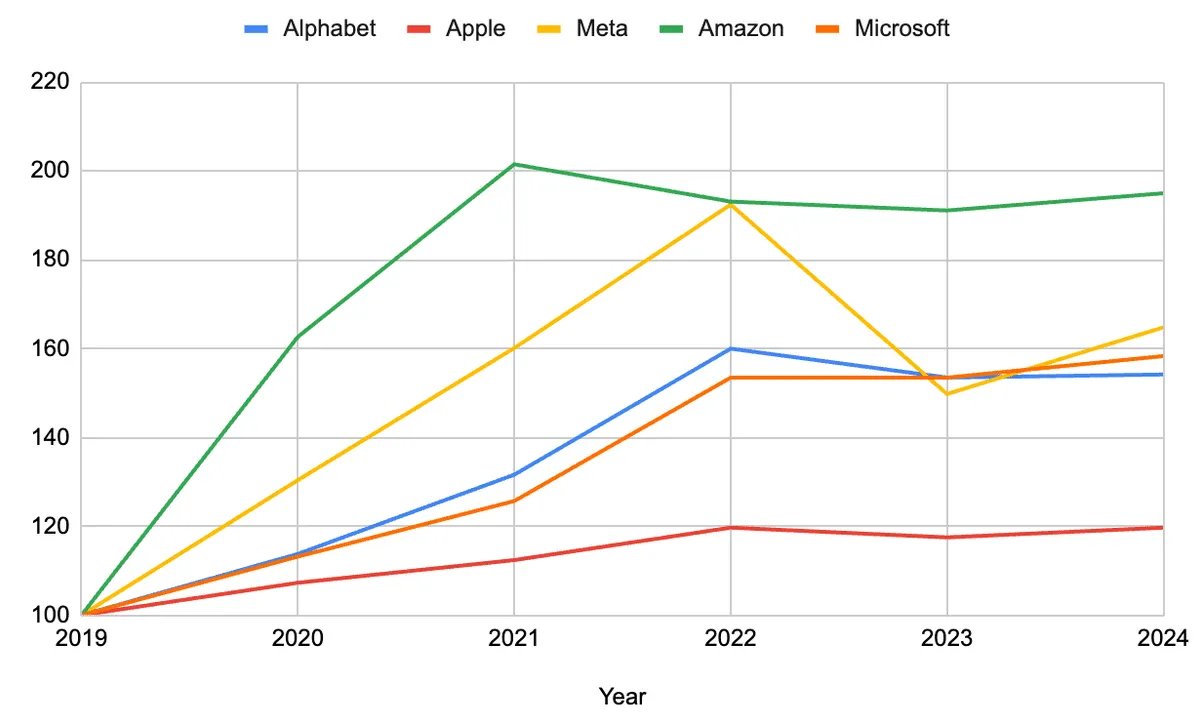 Figure 2: Big Tech headcount over time (indexed to 2019 = 100; compiled by the author from the data above).
Amazon stepped up hiring sharply during the pandemic, roughly doubling its workforce in just two years. That increase came to about 800,000 people. Headcount dipped slightly after that, but it remains at a high level today.
Meta also kept expanding rapidly through 2022. In 2023, partly because its metaverse/XR business was struggling (the business it had even renamed the company to focus on), it moved to large-scale job cuts. Even so, it still has more than 60% more employees than before the pandemic.
Google (Alphabet) likewise kept growing quickly through 2022, then cut a few percent of its workforce. Since then, its headcount has stayed roughly flat.
Microsoft ramped up hiring fast and later announced several rounds of layoffs, but in the end its headcount kept rising all the way through 2024.
Apple has been the most cautious hirer of the GAFAM companies. Even so, its current headcount is nearly 20% higher than before COVID.
So each company has hired and adjusted in its own way. But taken as a whole, every one of them still employs far more people than before the pandemic. Rather than seeing the recent layoffs as “jobs disappearing,” it is closer to the truth to see them as “letting a little air out of a balloon that had been overinflated for a while.” [8]
What’s more, Microsoft kept adding employees overall even after the COVID bubble burst. When it announced layoffs this year, isn’t the more convincing explanation not “anticipating the future of AI,” but “belatedly trimming what it over-added during COVID”?
After acquiring X (then still called Twitter), Elon Musk cut its workforce by about 80%. [9] That may be an extreme example, but American companies won’t hesitate to make decisions on that kind of dramatic scale when they judge it truly necessary.
The layoffs GAFAM is carrying out now amount to a few percent of employees at most. They hardly look like a serious, large-scale restructuring in anticipation of AI wiping out jobs. Seen in the context of the overall trend, “fine-tuning” seems the fair word for it.
Will AI really take our jobs?
That said, all of this is only about what has happened “so far.”
So what about the near future? Will a time come when adopting AI really does lead directly to “jobs disappearing”? More precisely, the question is this: will advances in AI reduce the total amount of work for humans?
Just as the spread of self-driving cars will mean less work for taxi drivers, some jobs being replaced by AI is already becoming a reality. At the same time, there are definitely new kinds of jobs that AI has created, such as AI engineers and data scientists.
So, looked at as a whole, will unemployment really go up? Or will new jobs keep things in balance?
To give you my conclusion up front: I’m only an owl living in the forest, and I honestly can’t tell.
Still, AI heavyweights like Sam Altman and Elon Musk say there will be fewer jobs, [10] [11] and the media loves to spread sensational headlines like “AI will steal human jobs.”
That’s exactly why I want to deliberately think about this from the opposite angle here.
Could AI and human desire create new jobs?
Will the age of AI really create new jobs in large numbers?
It’s a bit of a back-and-forth, answering one hypothetical with another. But the reason I think “that could happen too” lies in how deep human desire runs.
Once we achieve something, we want what lies beyond it. Human desire never runs out.
For example, now that AI has started writing code, part of the work of software engineers is being replaced. On the other hand, new software development work can also emerge from multiplying AI by human desire.
Let me give a concrete example.
There’s no reason the LINE app (Japan’s dominant messaging app) has to be a single app. There could just as well be a version of LINE customized for each person. For children, everything written in hiragana, Japan’s basic phonetic script. For people with low vision, large text and strong contrast. For older people, a simple UI with a pared-down set of features. Today that’s hard to pull off because of cost and resources. But if AI lowers that bar, new development needs that answer each individual’s “wouldn’t it be nice if…” will surely keep appearing, one after another.
Of course, this isn’t limited to software.
Many illnesses and injuries that were once fatal are now treatable, and lifespans have grown dramatically. Yet people still aren’t satisfied; some even dream of never aging or dying. Medicine, beauty, health: each has advanced on the fuel of humanity’s desire for “more,” giving birth to new industries and creating jobs.
Travel is the same. It’s no longer just about getting from A to B. People have come to want experiences that are faster, more comfortable and more personalized. You could say human desire has kept creating the next generation of “work.”
On top of that, a time should come when “what AI can’t do,” in other words what only humans can do, gains value. Customer service, caregiving, education, raising children. Fields where the “human warmth” that machines can’t replace is valued may become more and more important.
And there’s one more thing.
The desire to compare people with one another, ourselves with others, and rank who is better probably won’t go away either.
For instance, the more AI handles composing music, drawing illustrations and writing programs, the more people might, in turn, find value in things “made by humans” rather than by AI.
Contests, judging, skill competitions, personalized forms of expression: we may see more and more places where people show off and evaluate “who can do how much.”
New kinds of jobs and roles could be born there, too.
Summary
It may be premature to declare right now that “AI is taking our jobs.” As we’ve seen, the main drivers may well be the correction of rapid pandemic-era hiring and the reallocation of work using AI. You can’t simply equate AI with fewer jobs.
Of course, a reorganization of roles is unavoidable in the long run, and there’s a high chance some tasks will be automated. But at the same time, new demand and new roles are surely continuing to emerge.
Whether AI will reduce employment overall is a serious question. Still, I’d rather not be swept along by media headlines about “AI layoffs.”
As an owl, I’d like to live alongside AI without being overly optimistic or pessimistic, the way I watch the clouds drift by.
References
[1] NHK: Microsoft plans to cut about 9,000 more employees (in Japanese) [2] Bloomberg: Amazon tells some employees “relocate or resign,” raising concerns about quiet job cuts (in Japanese) [3] macrotrends: Alphabet - Number of Employees 2010-2025 | GOOG [4] macrotrends: Amazon - Number of Employees 2010-2025 | AMZN [5] macrotrends: Apple - Number of Employees 2010-2025 | AAPL [6] BullFincher: Microsoft Corporation’s Number of Employees [7] BullFincher: Meta Platforms’s Number of Employees [8] Medium: Layoffs or Rebalancing? What 10 Years of Big Tech Hiring Data Really Tells Us [9] FORTUNE: Elon Musk wants to gut the government like he did at Twitter. But his private sector strategies are going to be tested at DOGE [10] The Times of India: Sam Altman’s AI warning: Millions of jobs are at risk—here’s why [11] Independent: No one is safe - Elon Musk predicts AI is coming for all our jobs