
GAFAM NewsEssay
What is Meta selling with AI? The ad company being rebuilt behind the stock surge
Why Meta's AI bet is a redesign of its ad engine, not a cloud business, and what its spending, glasses and agents mean for its stock.
- First published in Japanese
- English edition
Good evening. The Owl here.
Meta’s stock has been moving sharply lately.
META closed at $578.54 on September 1, 2026. By September 24, it closed at $777.59. That is a gain of about 34% in only around 17 trading days.[1]
Of course, a share price alone doesn’t decide what a company is really worth. The move also reflects hopes for AI stocks in general, analyst ratings and investor speculation. Even so, it seems clear that the market has started to look at Meta again, not as “the social media company that lost its way in the metaverse,” but as a serious contender in the AI era.
So what, exactly, is Meta trying to sell with AI?
How is it different from Microsoft, Google and Amazon, which sell cloud services to others, or from Apple, which sells devices? Let’s work through it together.
From $88 to $777: Meta’s stock has been a report card on its strategy
Over the past few years, META’s share price has reflected, quite bluntly, how much the market believes in the company’s strategy.
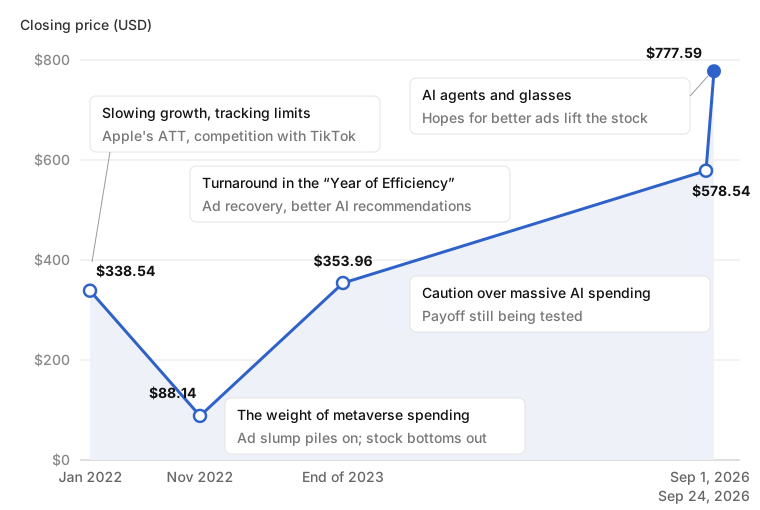
META’s stock price and its strategic turns. Closing prices in US dollars. The lines between points only trace the strategic turning points.
In 2022, Meta lost more than 70% of its value from the start of the year, one of the worst performances of any company in the GAFAM class.[2] But in 2023 it pivoted to a “Year of Efficiency,” cutting staff and tightening costs, and with the ad market recovering and AI recommendations improving, the stock came roaring back.[3]
The important thing is not to read today’s rally as proof that Meta has finished turning AI into money. More precisely, the market is pricing in two things ahead of time: that Meta can use AI to improve its ad business, and that it might be able to grow AI agents and AI glasses into its next sources of revenue.
Expectations are high. That is exactly why this is a company that swings hard when it disappoints.
The youngest of the GAFAM companies, and the one most shaped by its founder
Among the GAFAM companies, Microsoft and Apple rose in the PC era, and Amazon and Google in the internet era. Facebook was founded in 2004, before the iPhone existed, but it clearly became a giant in the mobile era.
Calling Meta a “mobile-era” company in this scheme is less about its founding year than about its growth model. People take photos, watch videos, message friends and respond to ads on the smartphone in their pocket. Meta is the company that turned that habit itself into a business.
And of the GAFAM companies, Meta is the only one where the founder is still on the front line as CEO and also holds a majority of the voting power. Its 2025 annual report states that Mark Zuckerberg has the control to decide matters such as the election of directors and major investments.[4]
That is a strength, and also a risk.
Google’s founders have stepped back from day-to-day management, and Amazon’s Jeff Bezos has left the CEO role. It has already been 15 years since Steve Jobs died, and John Ternus has only just become Apple’s CEO. Bill Gates, too, stepped away from Microsoft long ago.
At Meta, by contrast, Zuckerberg’s convictions can turn directly into capital allocation on the scale of tens of billions of dollars. Both the big pivot to the metaverse and the sharp swerve into AI were probably only possible because of this governance structure.
It has diversified, yet its revenue still stands on ads
Meta owns Facebook, Instagram, WhatsApp, Messenger and Threads. Judging only by the lineup of services, it looks well diversified.
Its revenue, though, stands, surprisingly, on just one leg.
Of its $60.801 billion in revenue in the second quarter of 2026, advertising brought in $59.363 billion. That is about 97.6%.[5] Paid messaging on WhatsApp, subscriptions and hardware sales are growing, but none of them has yet become a pillar that could replace advertising.
Meta is a company that has diversified its services. It is not a company that has managed to diversify its revenue.
This is the decisive difference from Google. Google also depends heavily on ads, but Google Cloud booked $24.8 billion in revenue in the second quarter of 2026.[6] Amazon has AWS, and Microsoft has Azure and Microsoft 365. Even as their AI investments balloon, there is a visible path to earning them back as enterprise cloud and software revenue.
Meta has no such path.
Its AI investments are earned back first by making ads more precise and content recommendations better, which raises the time users spend and the results advertisers get. In other words, before Meta’s AI is a new business, it is a redesign of its ad engine.
The metaverse was a failure, but something was left behind
In October 2021, Facebook renamed itself Meta and declared itself “metaverse-first.”[7] I think Zuckerberg wanted to own the next dominant platform himself.
The idea was to escape a position where Meta depended on Apple’s and Google’s smartphone operating systems and had to live by their rules on ad measurement and app distribution. Make VR and AR the next smartphone, and control the gateway to it. The strategy made sense.
But people didn’t wear headsets in daily life. Developers didn’t build a huge economy around them either. Reality Labs posted an operating loss of $13.72 billion in 2022, and was still $19.19 billion in the red in 2025.[8][9]
On top of that, several blows landed at the same time: tracking limits from Apple’s App Tracking Transparency (ATT), a weak ad market, and competition with TikTok. The metaverse was not the only reason the stock fell. Still, there is no doubt that continuing to pour money into a hugely loss-making business while ads were struggling deepened the market’s distrust.
Even so, it is a little early to dismiss Reality Labs as money thrown away.
By shifting its focus from VR headsets to AI glasses, Meta has returned to its original question. Where is the next screen? After the smartphone, what will be the gateway through which people talk to AI?
Its new answer is not a heavy headset but glasses you can wear every day.
Meta didn’t “pivot to AI.” It changed what AI is for
Meta is not an AI latecomer. It has contributed deeply to the technical foundations of AI.
It nurtured PyTorch and has released Llama openly. PyTorch grew out of collaboration between Facebook’s researchers and an outside community, and became a framework widely used in AI research.[10] Meta also released Llama 2 free of charge for both research and commercial use, and made it available on Microsoft Azure and AWS.[11]
Its earlier AI strategy, however, leaned heavily toward “publish research and improve recommendations and ads.” Now it has moved a step further and is trying to make money from AI in three stages.
The first is improving recommendations and ads. In Meta’s second quarter, ad impressions rose 14% year over year, and the average price per ad rose 12%. Meta itself names better targeting and measurement as one of the main reasons.[5]
The second is personal AI agents. Muse Spark, developed by Meta Superintelligence Labs, is being rolled out across Meta AI, WhatsApp, Instagram, Facebook, Messenger, Threads and AI glasses.[12]
The third is business customers. On the earnings call, Zuckerberg said Meta is looking at APIs, agents for businesses, and eventually even selling computing capacity directly.[13]
Here, for the first time, Meta has started to present revenue sources beyond advertising not just in words but as a business plan.
In the data center race, Meta is not a seller but one of the biggest buyers
Compare the GAFAM companies in the AI era, and the differences come into sharp focus.
| Company | Recent AI-infrastructure-related business |
|---|---|
| Microsoft | Microsoft Cloud revenue of $59.3 billion; Azure annual revenue of more than $100 billion |
| Google Cloud revenue of $24.8 billion | |
| Amazon | AWS revenue of $42.2 billion, operating income of $16.6 billion |
| Meta | No business selling cloud services; uses computing capacity for its own services |
Accounting categories differ from company to company, but Microsoft, Google and Amazon can earn back their data center investments as revenue from cloud services sold to others.[6][14][15]
Meta is different. Using AI data centers, its own MTIA chips, GPUs and outside cloud services, it consumes the computing capacity itself to run ads, recommendations, generative AI and glasses.[16]
Capital expenditure in the second quarter of 2026 was $31.08 billion. For the full year, Meta expects $130 billion to $145 billion.[17] In the same quarter, revenue grew 28% while costs and expenses grew 55%, and operating income fell 8% year over year.
That is where Meta stands today.
Its AI spending is on a hyperscaler scale. But it is not built to earn that money back from outside customers as cloud fees. Meta is betting on a loop: the strength of the ad business funds the AI investment, and that AI makes the ad business stronger still.
If it works, Meta can use AI to lift the productivity of its ads another notch. If it fails, it will be left with nothing but enormous investments, and no cloud revenue to cushion the blow.
The glasses are not a rehash of the metaverse
Meta’s AI glasses are, admittedly, a sequel to its metaverse strategy. But they don’t repeat the same mistake.
The metaverse asked users to “please step into a new virtual space.”
AI glasses do the opposite. As you look at the real world around you, they help with translation, directions, taking photos, conversation and search. The aim is to gradually reduce the number of times you pull out your phone.
Meta says that in the second quarter of 2026, the growth in Reality Labs revenue came mainly from higher sales of AI glasses, which made up for lower sales of Quest headsets.[5] And at Connect 2026, it laid out a plan to offer more than 100 kinds of AI glasses by the end of the year.[18]
It is not yet a profitable business. Reality Labs posted an operating loss of $4.619 billion in the second quarter alone.[17]
Even so, glasses matter a great deal to Meta. They let it place AI not only inside apps but close to the body. Rather than an ad company trying to build the next operating system, Meta is trying to secure the next interface through AI. For Meta today, that is far more realistic.
Closing thoughts
Meta’s strategy is not a story of giving up on the metaverse and running away to AI.
It is using the enormous profits from its ad business to go after the next dominant platform. What has changed is the means: from a VR-centered metaverse to AI recommendations, personal agents, AI for businesses, and glasses.
What the market is rewarding now is not the idea that Meta could become a cloud company like Microsoft or Amazon. It is the possibility that Meta can embed AI in services used by more than 3 billion people, and turn its heavy reliance on ads into a source of investment funding rather than a weakness.
The fact remains, though, that advertising makes up about 98% of its revenue. We will be able to say Meta has truly entered its second chapter not when AI improves its ads, but when AI produces lasting revenue beyond advertising.
🦉Just as a young owl learns to fly by “branching,” hopping from limb to limb and failing along the way, perhaps Meta, too, is learning how to turn the expectations around AI into everyday life and real revenue. All in preparation for the day it finally spreads its wings.
References
[1] Stock Analysis: Meta Platforms Stock Price History
[2] Reuters: Meta cuts 11,000 jobs as it sinks more money into the metaverse
[3] AP News: Meta posts sharp profit, revenue increase in Q4 thanks to cost cuts and advertising rebound
[5] SEC: Meta Platforms Q2 2026 Form 10-Q
[6] SEC: Alphabet Announces Second Quarter 2026 Results
[7] Meta: Introducing Meta: A Social Technology Company
[8] SEC: Meta Platforms 2022 Annual Report
[10] Meta AI: PyTorch builds the future of AI and machine learning at Facebook
[11] Meta AI: Community-driven AI innovation comes alive with Llama 2
[12] Meta: Introducing Muse Spark: Meta’s Most Powerful Model Yet
[13] Meta: Q2 2026 Earnings Call Transcript
[14] Microsoft: FY26 Q4 Earnings Release
[15] Amazon: Amazon.com Announces Second Quarter Results
[16] Meta: What Is Compute Power? Meta’s AI Infrastructure Explained