
GAFAM NewsEssay
What Big Tech bet on in 2025: the latest earnings and the race for AI dominance
Q4 2025 earnings from Alphabet, Apple, Meta, Amazon and Microsoft show where each is betting on AI, what the capex boom means, and how it reaches Japan.
- First published in Japanese
- English edition
Good evening. The Owl here.
Between late January and early February 2026, every GAFAM company finished reporting its results for October–December 2025 (Q4). If you only skim the numbers, the impression may be “higher revenue and higher profit, again.” But seen from up in the tree, the view looks a little different.
With this round of earnings, each company’s AI “bet” has started to take on a clear shape. Search, cloud, hardware, social media advertising: five companies fighting on different fields, and all five have declared AI investment on an astronomical scale. Let me try to read, in my own owlish way, what that means and how it affects our lives and work.
First, a look at the numbers
Put the five companies’ Q4 2025 results side by side, and this is the picture that emerges.
| Company | Q4 revenue | YoY | Operating income | AI-related highlight |
|---|---|---|---|---|
| Amazon | $213.4B | +14% | $25.0B | AWS +24%, $35.6B |
| Apple | $143.8B | +16% | — | Services +14%, $30.0B |
| Alphabet (Google) | $113.8B | +18% | $35.9B | Google Cloud +48%, $17.7B |
| Microsoft | $81.3B | +17% | $38.3B | Azure +39%, Copilot 15 million seats |
| Meta | $59.9B | +24% | — | 2026 CapEx plan $115-135B |
(Source: each company’s earnings materials. Apple’s operating income is shown as “—” because it differs from the reported basis. Meta also discloses quarterly operating income separately.)
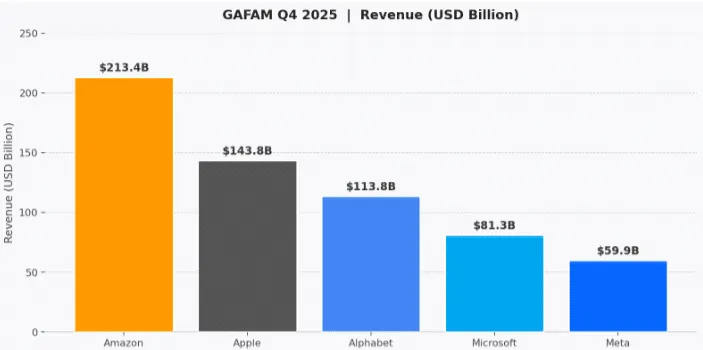
Figure 1: GAFAM Q4 2025 revenue comparison (USD billions)
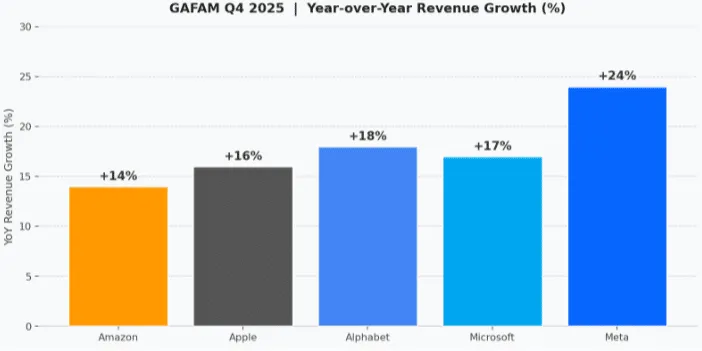
Figure 2: GAFAM Q4 2025 year-over-year growth rates
Combined revenue for the five companies came to about $612.2 billion (about ¥91 trillion). Every one of them achieved double-digit growth year over year, and Meta’s +24% stands out.
Meanwhile Amazon, the largest by scale, grew a comparatively modest +14%. That is the fate of a company that is “already too big.”
A test for the king of search: Alphabet (Google)
Revenue $113.8B (+18%) / Google Cloud $17.7B (+48%)
For full-year 2025, Alphabet crossed the $400 billion revenue mark for the first time ($403 billion)[1].
Search advertising is still the main earner, with Google Search as a whole growing +17%. Despite worries that “AI will eat search,” search remains solid.
The real story is the rapid expansion of Google Cloud. Its +48% growth rate beats both AWS (+24%) and Azure (+39%). Google has succeeded in capturing demand for AI infrastructure, and its backlog (contracted revenue not yet recognized) more than doubled year over year to $240 billion[1]. Demand for AI-ready services is quite literally making the cloud business explode.
The one that struggled was YouTube advertising. It grew to $11.38B (+9%) but fell short of the analyst consensus of $11.84B. Meanwhile the Gemini AI app reached 750 million monthly active users (up 100 million from the previous quarter), and Google says it cut the cost of serving the model by 78% over full-year 2025, an impressive figure[1].
Record iPhone and Services: Apple
Revenue $143.8B (+16%) / iPhone $85.3B (+23%) / Services $30.0B (+14%)
Apple’s Q1 FY2026 (October–December 2025) was a quarter of records. Revenue of $143.8 billion was the highest ever for that period. iPhone jumped +23%, setting all-time records in every region[2].
The Services segment deserves special mention. At $30 billion (+14%), it set records in every category: advertising, cloud, music and payments. What emerges is a picture in which not just App Store commissions but also built-in Apple Intelligence (Apple’s AI features) is lifting Services usage.
Also notable is the recovery in China (including Hong Kong and Taiwan): revenue of $25.5 billion, a sharp rebound of +38%. Whether Apple’s AI features really roll out in China will be the next key question.
On the other hand, Mac revenue fell 7%, which hints that the benefits of AI have not yet spread evenly across all of Apple’s products[2].
The quarter “all-in on AI” paid off: Meta
Revenue $59.9B (+24%) / Full-year FY2025 $201.0B (+22%)
Meta posted the highest revenue growth of the five. The numbers seem to vindicate CEO Mark Zuckerberg’s “all-in on AI” strategy[3].
Advertising drove the growth. AI-optimized ad delivery became more precise and paid off: price per ad rose 6% and ad impressions rose 18%, so both engines were firing. Daily active people (DAP) reached 3.58 billion (+7%), which works out to roughly 44% of all humanity using Meta’s services every day.
The surprise was the 2026 CapEx (capital expenditure) plan. The figure of $115–135 billion includes investment in a newly created AI team, Meta Superintelligence Labs, and signals a serious bet with generative AI and AGI (artificial general intelligence) in its sights[3].
Still, while AI-driven precision is a tailwind for Instagram and Facebook advertising, upward pressure on ad prices is expected to continue. Dealing with scam ads (you may remember the lawsuit involving Yusaku Maezawa, the Japanese entrepreneur, and others) also remains a challenge.
A three-way cloud race: AWS, Azure and Google Cloud
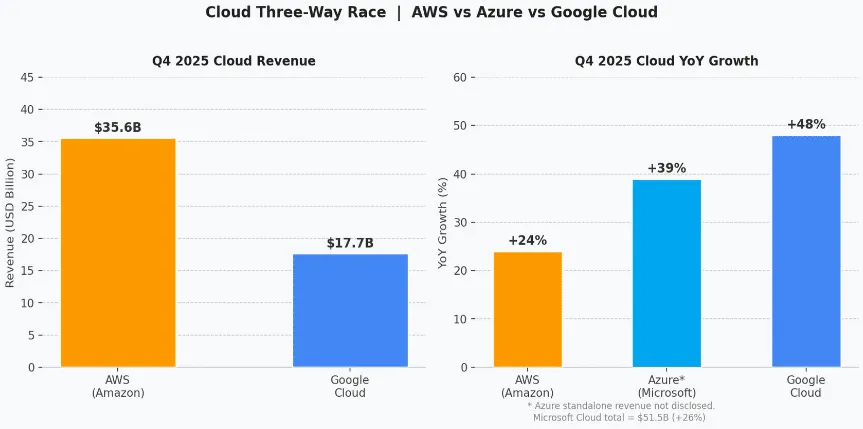
Figure 3: Revenue of the three cloud providers (left) and year-over-year growth (right). Microsoft does not disclose Azure’s standalone revenue, so only its growth rate is compared.
The cloud is where the infrastructure battle of the AI era is fiercest. AWS at $35.6B (+24%), Azure at +39%, Google Cloud at +48%: all three cloud giants keep growing fast.
AWS (Amazon)
It has the largest revenue of the three but trails on growth. Even so, its highly profitable model, with a 35% operating margin, is rock-solid, and AWS still supports most of Amazon’s profit[4].
Azure (Microsoft)
Its partnership with OpenAI, the developer of ChatGPT, keeps pulling customers toward Azure. Its remaining performance obligation (RPO), or order backlog, rose 110% year over year to $625 billion, and the fact that 45% of it is tied to OpenAI also shows how deep that dependence runs[5].
Google Cloud (Google)
The fastest growth of the three. Its $240 billion backlog speaks to the strength of demand. Its enterprise AI services built around Gemini are earning a growing reputation[1].
Investment or bubble? The astronomical AI capex
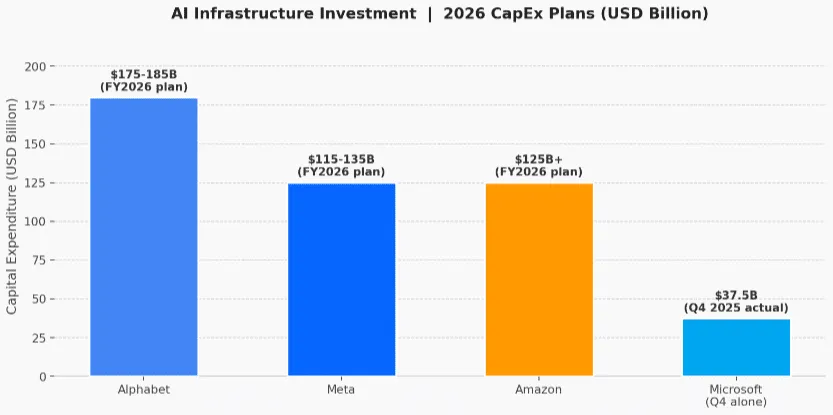
Figure 4: Comparison of 2026 AI capex plans (Alphabet shown at the $175–185B midpoint)
Add up the 2026 CapEx plans of four of the companies and you get at least about $460 billion (about ¥69 trillion). Investment equal to about 60% of Japan’s national budget (about ¥112 trillion, roughly $720 billion) is about to be poured into tech companies’ AI infrastructure in a single year[1][3][4][5].
The market is only half convinced that this much investment will really pay off. After Alphabet’s Q4 results, its stock fell about 3% despite higher profit. Worries about “too much CapEx” wiped out the good results.
What caught my eye, though, was how this investment breaks down. Microsoft spent $37.5 billion on CapEx in Q4 alone, and two-thirds of it went to “short-lived assets” (GPUs and the like), in other words a concentrated investment in infrastructure that can be monetized right now[5]. It is less “a bet on the future” and more, in large part, “investment to catch up with today’s demand.”
And while investment on this scale is a business opportunity for the power, semiconductor, construction and cooling-system industries, energy consumption is also emerging as a very real problem.
What lies behind the numbers: the Owl’s view
Here are three things I took away from this earnings season.
1. AI is turning from a “cost” into “revenue”
A few years ago, AI investment was described as “planting seeds for the future.” In this round of earnings, though, Google Cloud, Azure and AWS are already seeing real revenue surge on AI demand. In other words, AI is no longer a cost center; it has started to work as a business that generates profit. This turning point matters.
2. The winners are gathering not around “AI itself” but around “the infrastructure that runs AI”
AI models such as Gemini, Copilot and Meta AI get better to use by the day, but what is reliably making money right now is the cloud infrastructure that supports them. There is an ironic picture here: for now, “the servers that run AI” earn more than “AI apps.”
3. Apple is playing a different game with a “quiet AI” strategy
Unlike the other four, Apple has not joined the AI CapEx race. Instead it is quietly rolling out Apple Intelligence on its devices and steadily growing Services revenue. The path of “AI that feels good to use” rather than “noisy AI” may be an approach that resonates especially with Japanese users.
The ripple effects on Japanese companies and consumers
When AI investment by the five GAFAM companies reaches this scale, Japan cannot escape the impact. Here are three ripple effects I am watching in particular.
1. The cost of adopting AI is falling for companies
Just as Alphabet cut Gemini API costs by 78%, the cost of using AI technology is dropping fast. Even for Japan’s small and mid-sized companies, using cloud AI to streamline back-office work and automate marketing is becoming a realistic option.
2. Business opportunities for power and infrastructure industries
Astronomical AI capex sends data center power demand soaring. In Japan too, GAFAM companies that run their own data centers keep adding to their power contracts. The opportunity for renewable energy, power utilities and cooling-technology companies is large. In fact, the stock prices of related Japanese companies have already shot up.
3. The digital ad market will become even more AI-driven
The further Meta’s and Google’s AI ad optimization goes, the sooner the era of “a person setting up ads on intuition” ends. For Japan’s ad agencies and social media marketers, shifting toward people who can handle AI tools will become urgent.
Closing thoughts
For GAFAM, 2025 was the year they proved in numbers their resolve to “bet on AI.” Despite their differences in size, all five achieved double-digit growth and all five declared huge AI investments, and that fact clearly shows the direction of the technology industry.
One question remains. Will this much investment truly make our lives richer? Or will only a handful of companies and people reap the benefits…?
…Every night, I look down on the city and its lights. To an owl’s eyes, every light looks the same size. But come closer, and some lights are warm while others are cold. In what color will GAFAM’s light shine on people’s lives? I plan to keep quietly watching through 2026.
References
[1] Alphabet reports Q4 2025 revenue of $113.8 billion (9to5Google)
[2] Apple reports first quarter results (Apple)
[3] Meta Reports Fourth Quarter and Full Year 2025 Results (Meta)
[4] Amazon Q4 FY 2025: Revenue Beat, AWS +24% Amid $200B Capex Plan (Futurum)
[5] Microsoft Q2 FY 2026: Cloud Surpasses $50B; Azure Up 38% (Futurum)
[6] Alphabet Announces Fourth Quarter 2025 and Fiscal Year Results (Alphabet IR)
[7] Microsoft reveals just 3.3% of Copilot Chat users pay for it (The Register)