
GAFAM NewsEssay
How much electricity does AI actually use? The numbers behind Big Tech's energy war
AI's power appetite in plain numbers: data center growth, Big Tech's usage vs. all of Tokyo, local grid strain, nuclear bets, and the Hormuz energy risk.
- First published in Japanese
- English edition
We often hear that AI consumes a lot of energy.
The electricity that GAFAM pours into AI on a global scale has an especially large impact. But how big is it, really? It’s hard to picture.
This time I’ll dig into the scale and the reality using numbers and comparisons that humans and owls alike can follow. Then I’ll try to work out what this could mean for our everyday lives.
The United States has also just launched a military strike on Iran, raising fears of soaring energy prices. I’d also like to think through with you how that could affect the business of GAFAM, which keeps pouring electricity into AI.
How big AI’s power use is within the world’s electricity consumption
To get a sense of scale, let’s start with the big box: the world’s total electricity consumption.
According to IEA estimates, global annual electricity consumption reached about 30,856 TWh in 2024. The number is so large it’s hard to grasp, so just remember “about 30,000.” That was a 4.3% increase over the previous year, more than double the average annual increase of the past decade [1].
How much of that big box do data centers take up? Data center consumption in 2024 was about 415 TWh. Roughly 400 against that 30,000, which works out to about 1.5% of the world’s total electricity consumption [2].
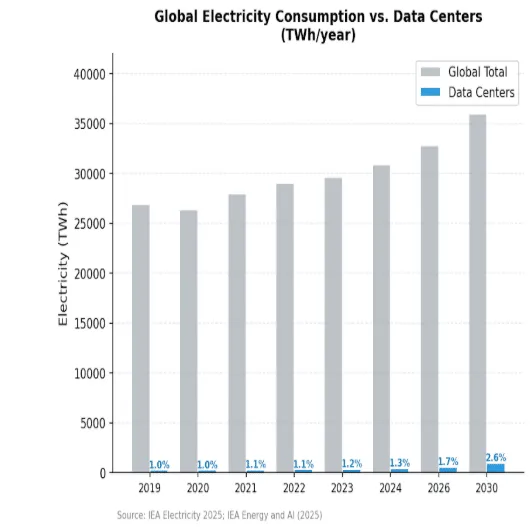
Global electricity consumption and data center electricity consumption over time
At first glance that looks small. But the growth rate tells a different story.
Data center electricity consumption has grown 12% a year over the past five years, nearly three times the pace of overall growth (4.3%).
If this continues, data centers will weigh more heavily in the growth of global electricity demand every year. In 2024, data center growth (about 45 TWh) was still only a part of the total increase in electricity consumption (about 1,300 TWh). But the IEA projects data center consumption to nearly double to 945 TWh by 2030 [2].
Electricity for AI-dedicated servers in particular is growing 30% a year, a pace that stands far above the rest.
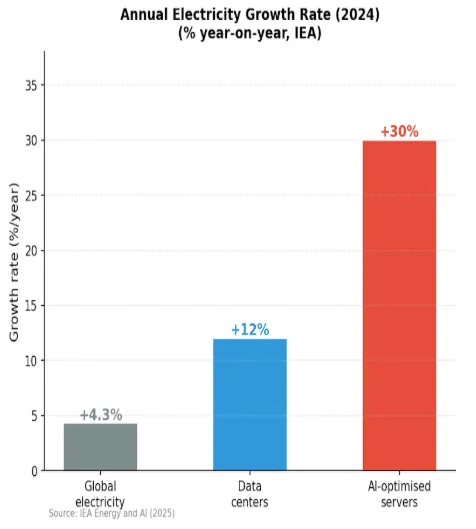
Comparing growth in electricity consumption
And the extra energy use that AI’s spread brings isn’t limited to data center consumption.
The biggest drivers behind the accelerating growth of global electricity consumption are AI and the semiconductor industry, and that trend is expected to grow stronger.
The electricity GAFAM’s data centers swallow
Let’s zoom in to the level of GAFAM.
With the latest reports each company published in 2025, the 2024 data is now in.
According to Google’s official environmental report, its data center electricity consumption in 2024 was 30.8 TWh, up 27% year over year [3]. That’s close to 2.5 times the roughly 12.4 TWh of 2019, five years earlier, and you can see growth accelerating in 2023–24, when the AI boom took off in earnest.
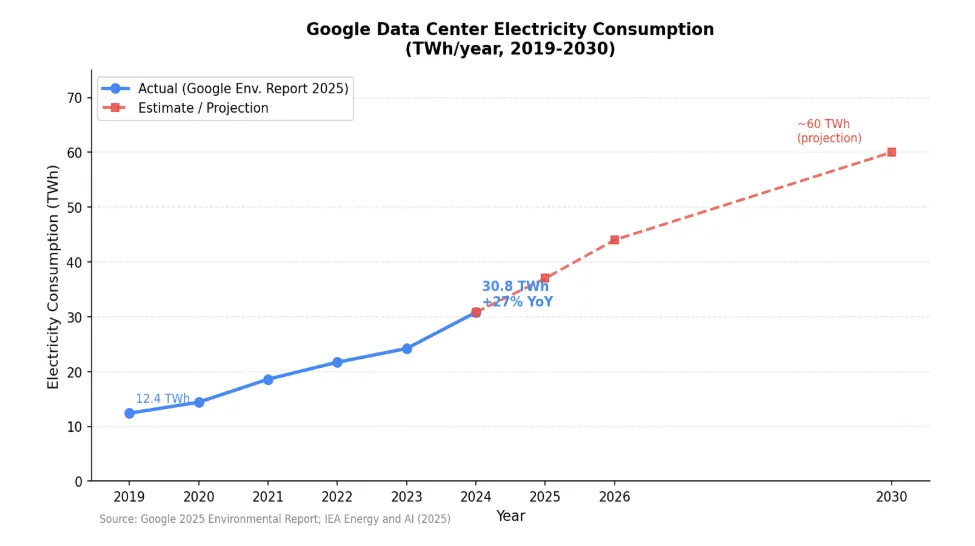
Google’s data center electricity consumption over time
To put that 30.8 TWh on a more familiar scale, it equals about 40% of Tokyo’s total annual electricity consumption (about 76.97 TWh in 2024, per the Ministry of Economy, Trade and Industry (METI) [4]).
And according to a Ministry of the Environment survey, a typical Japanese household uses about 330 kWh of electricity a month [5], or about 3,960 kWh a year. By that math, Google’s annual consumption equals the usage of about 7.78 million such households.
Microsoft, like Google, reports about 30 TWh (up 27% year over year) [6], and Meta is put at about 15 TWh [7].
The four companies together are estimated to exceed 100 TWh. In other words, GAFAM alone uses more electricity than all of Tokyo consumes in a year.
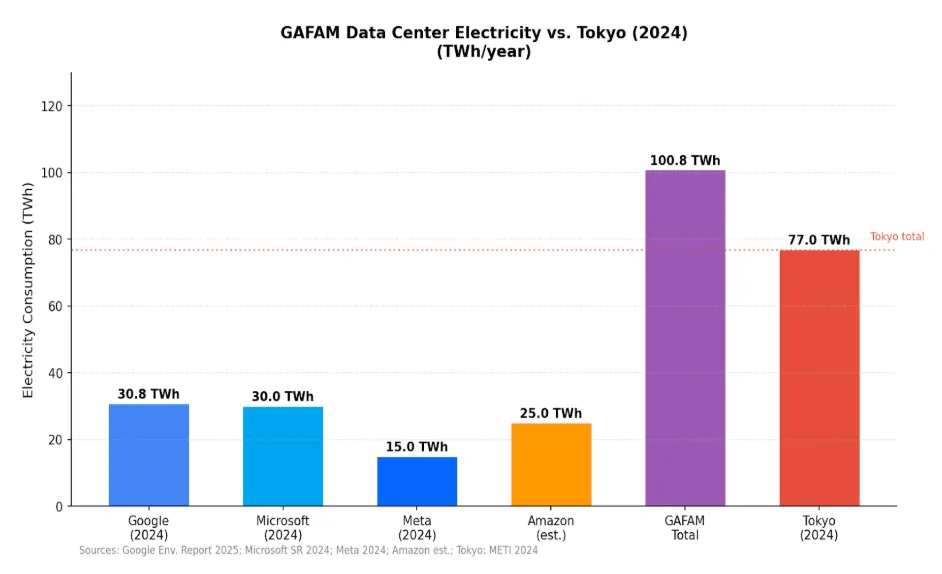
GAFAM data center electricity consumption vs. Tokyo’s electricity consumption (annual, estimated)
The shadow of the numbers: what’s happening where data centers cluster
Worldwide, data centers account for 1.5% of electricity consumption. But in the specific regions where facilities concentrate, it’s a completely different story.
Northern Virginia, North America’s largest data center hub, accounts for 13% of the world’s operating data center capacity and 25% of North America’s [8]. In this region, the clearing price in the 2024–25 electricity capacity auction reportedly jumped 833% from the previous year [9]. An estimate by the state legislature’s research commission suggests that if data centers keep multiplying at this rate, the typical household’s annual electricity bill could rise by $444 (roughly ¥60,000) by 2040 [10].
Japan is no exception. Data center electricity consumption was about 19 TWh as of 2024, and one forecast has it more than tripling to 57–66 TWh by 2034 [11]. More than 90% of facilities are concentrated in Tokyo and the Kansai region, and by 2030 data centers are expected to account for about 7% of the electricity load in the greater Tokyo and Kansai areas [12]. In some areas, the wait for a grid connection now stretches as long as seven years. Power infrastructure simply can’t keep up.
When GAFAM and other global tech companies announce data center investments in Japan, the emphasis is on job creation and economic ripple effects. The strain on power infrastructure, the risk of costs being passed on to electricity bills, and the contradiction with decarbonization goals rarely come to the surface.
Only the bright side of these investments tends to get told. That’s something local residents and policymakers should keep in mind.
Two angles for understanding AI’s power use
So far I’ve treated AI’s electricity consumption as a single lump. Let’s also look at what it’s made of.
AI consumes electricity at two main stages: training and inference.
Training is the process of building a large model like GPT-4 or Gemini from scratch. It keeps thousands of GPUs running nonstop for weeks or months, so a single training run is said to consume anywhere from several GWh to tens of GWh [13].
Until now, much of data centers’ resources have gone to training. That was driven by the race among companies vying for dominance in the AI era to build foundation models, together with scaling laws, the idea that model performance scales with the amount of data.
Inference, on the other hand, is the processing that happens when users actually ask AI something. Each instance uses little power, but it adds up to an enormous amount.
A single query to ChatGPT (GPT-4o class) is said to use about 0.3–0.5 watt-hours (Wh) of electricity on average [14]. And ChatGPT reportedly receives more than 2.5 billion prompts every day (Business Insider, 2025) [15]. So what happens when a small amount of consumption piles up 2.5 billion times?
One question to ChatGPT (about 0.4 Wh) ≈ the electricity to light an LED bulb (8 W) for about 3 minutes
One day of ChatGPT (about 1 GWh) ≈ the electricity about 100,000 typical Japanese households use in a day
Google Search, meanwhile, is estimated to handle more than 13.5 billion searches a day on average [16].
AI search (search with Gemini built in) is said to sometimes use several times to as much as 10 times the electricity of a conventional search [17], and Google keeps increasing its share.
Suppose 80% of all searches became AI searches, and roughly apply the same 0.4 Wh per query as ChatGPT. That comes to about 4 GWh a day, or about 1.5 TWh a year. That’s more than four times the annual estimate for ChatGPT (about 365 GWh), which shows how much electricity the accumulation of inference can add up to.
Small as it looks, piled up it becomes enough energy to run a whole city.
That’s the reality of AI’s power consumption. As the center of gravity in how AI is used shifts from training to inference, inference is expected to take an even larger share of AI’s electricity demand.
Surging AI investment and the coming wave of power demand
GAFAM will remain the main force pushing up AI’s power consumption, and the investment side backs that up.
The 2025 data center investment plans the companies announced are on an unprecedented scale. Microsoft at about $80 billion [18], Google at about $85 billion [19], and Meta at $66–72 billion [20]. The GAFAM total is expected to top $350 billion, an estimated increase of about 40% from the previous year (about $250 billion) [21]. This investment covers not only GPU servers but also power infrastructure, substations and cooling systems.
The key point is that data centers whose construction began in 2025 will actually start operating between 2026 and 2028. The big wave of power demand is still ahead.
If the power supply problem isn’t solved now, the stable delivery of AI services itself could be at risk. That’s why the companies are leaning so far forward to secure power.
The gap between betting on nuclear and renewables and reality
Facing this demand, GAFAM is moving to secure power sources well ahead of time.
Google has signed a deal to procure 500 MW from small modular reactors (SMRs), targeted for around 2030–35 [22]. Amazon has secured 320–960 MW of nuclear-derived power [23]. Microsoft plans to restart the Three Mile Island nuclear plant in 2028 to obtain 837 MW [24]. And Meta has reportedly agreed to more than 6.6 GW of SMR and nuclear procurement [25].
Even a seemingly far-fetched plan to build data centers in space is being seriously considered. Google is testing the feasibility of space-based data centers under the name “Project Suncatcher,” with a test satellite launch scheduled for 2027 [26].
But in every case, the power won’t actually flow until the early 2030s at the earliest.
SMRs face technical and regulatory hurdles, and there’s some uncertainty about whether they’ll stay on schedule. Solar and wind output depends on the weather, which makes it hard for them alone to support AI’s need for stable, around-the-clock operation every day of the year.
According to IEA analysis, more than 40% of US data center electricity currently comes from natural gas [2].
For the next several years, until the shift to clean energy is fully underway, the industry isn’t expected to break free of fossil fuels entirely.
In Japan, too, most renewable energy is located in rural regions while data centers cluster in metropolitan areas, so transmission losses and grid stability have emerged as policy issues.
It’s tempting to focus on the visionary stories. But for at least the next five years, GAFAM’s AI development and rollout will have no choice but to rely on existing fossil fuels. The day that fact hits our lives hard is not far off at all.
The Strait of Hormuz crisis and the chain reaction in AI costs
Actually, that day may already be here.
In March 2026, the US military’s attack on Iran sharply heightened fears about the risks of passage through the Strait of Hormuz.
The Strait of Hormuz is a main artery of the world’s energy supply: about 20% of global oil trade and about 20% of liquefied natural gas (LNG) trade pass through it [27].
Natural gas is one of the main power sources for data centers. If the situation in the Middle East worsens and LNG exports from Qatar stall, Goldman Sachs estimates that global LNG supply could fall by as much as 19% in the near term [28].
There are also reports that as tensions escalated, European natural gas futures nearly doubled, from about €30 per MWh to about €60 [29]. Freight rates for LNG tankers have also been seen jumping more than 40% [30].
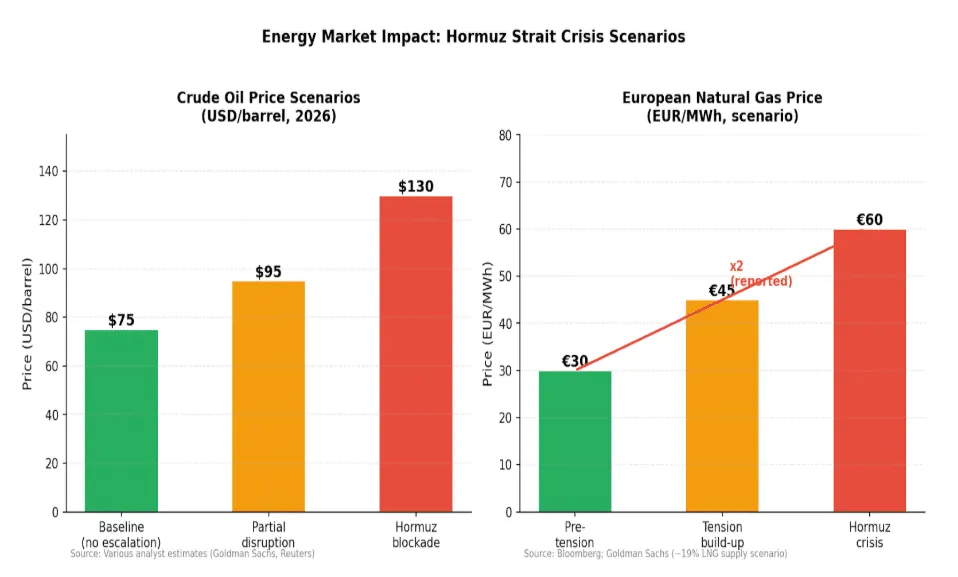
The Strait of Hormuz crisis and its impact on oil and natural gas prices
For countries like Japan that depend on fossil fuels for much of their energy, layering the supply risk from the Hormuz situation on top of AI and data centers’ ever-growing energy demand is a harsh double blow.
In terms of our own lives, rising energy costs push up data center operating costs, and that could eventually show up as price revisions for AI cloud services or reviews of new data center plans.
A bigger risk is a scenario in which these rising costs squeeze GAFAM’s profit structure, and a sudden headwind hits AI-related stock prices that have been built up on expectations of growth. That fear can’t be dismissed as groundless.
Summary
Looking back over this article, three structural tensions stand out.
First, the gap between accelerating AI investment and the reality of power supply.
While global electricity consumption as a whole grows at around 4% a year, data centers keep growing at 12% a year, nearly three times as fast. The companies are moving on nuclear power and SMRs to secure power for the years ahead, but those won’t come online until the 2030s at the earliest. Given that in 2024 the four GAFAM companies alone already exceeded Tokyo’s total electricity consumption, the scale of the problem is clear.
Second, the gap between the global numbers and the local impact.
Worldwide the share may be 1.5%, but in places where facilities cluster, such as Virginia or Tokyo and Osaka, electricity prices move sharply and infrastructure can’t keep pace. When GAFAM promotes its investments in each country and region, information about these downsides is hardly ever shared.
Third, the unexpected link between Middle East geopolitical risk and digital infrastructure.
The fact that the foundation of cutting-edge AI is vulnerable to a geopolitical bottleneck like the Strait of Hormuz is something we can’t overlook when thinking about the stable supply of digital services.
In the quiet of the night, an owl pricks up its ears and listens for movements the eye can’t see.
Electricity looks like an unglamorous issue, yet it is quietly setting the pace of the entire AI industry’s expansion. That is a textbook example of this kind of hard-to-see change.
If something moves next, it may show up not in a flashy announcement but first in power contract renewals or shifts in energy policy.
References
[1] Demand – Electricity 2025: global annual electricity consumption 30,856 TWh (+4.3%, 2024) (IEA)
[3] Google 2025 Environmental Report — data center electricity consumption 30.8 TWh (Google)
[4] Electric Power Statistics (Ministry of Economy, Trade and Industry) (in Japanese)
[5] Survey on CO₂ Emissions from the Residential Sector (Ministry of the Environment) (in Japanese)
[6] Microsoft 2024 Environmental Sustainability Report Data Fact Sheet
[7] Meta data center electricity consumption hits 14,975 GWh (Data Center Dynamics)
[8] Data Centers in Virginia — 13% of the world, 25% of North America (JLARC, 2024)
[9] Virginia’s New Data Center Electricity Rate Class — capacity prices up 833% (American Action Forum)
[11] Data center energy consumption in Japan to triple by 2034 (Data Center Dynamics)
[12] Japan’s $26 Billion Data Center Paradox — 7% of power load in Tokyo and Kansai by 2030 (Introl)
[13] Training Compute of Frontier AI Models Grows by 4-5x per Year (Epoch AI)
[14] How much energy does ChatGPT use? — about 0.34 Wh per query (Epoch AI)
[15] ChatGPT users send 2.5 billion prompts a day (TechCrunch, 2025)
[16] How many times a day is Google searched? (WebMA) (in Japanese)
[19] Google announces $85 billion investment plan for 2025 (Google Blog, 2025)
[20] Meta Q4 2024 Earnings: 2025 capex guidance $66–72 billion (Meta IR)
[21] Tech megacaps plan to spend more than $300 billion in 2025 as AI race intensifies (CNBC)
[22] Google signs advanced nuclear clean energy agreement with Kairos Power (Google Blog, Oct 2024)
[23] Amazon signs agreements for innovative nuclear energy development (aboutamazon.com, 2024)
[25] Meta Announces Nuclear Energy Projects, Unlocking Up to 6.6 GW (Meta Newsroom, Jan 2026)
[27] World Oil Transit Chokepoints: Strait of Hormuz (U.S. Energy Information Administration)