
GAFAM NewsMonthly roundup
Big Tech in March 2026: the light and the dark
March 2026: Apple at 50, a $110 billion OpenAI round and Meta's MTIA chips, against Big Tech stocks 14–35% off peak, a social media verdict and layoffs.
- First published in Japanese
- English edition
For GAFAM, March 2026 was a month of one glittering story after another on the light side: celebratory fireworks for Apple’s 50th anniversary, huge investments, acquisitions.
Behind all that, though, what concerns me most is that the share prices of all five GAFAM companies have fallen by roughly 15 to 35% from their peaks.[14][15]
I can’t help wondering whether this is an early sign that the assumption that “tech can do anything” is beginning to come crashing down.
With that, let’s look at this month’s news of light and dark.
The light side
Apple turns 50 and kicks off the celebration with a rush of new products
In March, as it approached its 50th anniversary, Apple announced a long list of new products, including the iPhone 17e, M5 models of the MacBook Air and MacBook Pro, and the MacBook Neo [1][2][3].
The iPhone 17e gets the A19 chip and doubles its storage to 256GB while keeping the same price. The MacBook Neo is the first Mac with an A-series chip, the A18 Pro used in iPhones, and it carries a strategic price of $599 (under ¥100,000 in Japan).
At this half-century milestone, a lineup that gets both price and performance right widens the doorway into the Apple ecosystem for students and first-time users in Japan, too.
Amazon and others invest more than ¥17 trillion in OpenAI
A group led by Amazon ($50 billion), SoftBank ($30 billion) and NVIDIA ($30 billion) put in a total of $110 billion (about ¥17 trillion), bringing OpenAI’s post-money valuation to $840 billion [4].
It is the largest funding round ever for a private company. Amazon also announced an expanded AWS partnership at the same time, and GAFAM’s ties with OpenAI are deepening fast.
Japan’s SoftBank made a massive bet of its own with $30 billion, a clear signal that the investment race around generative AI has entered a whole new scale.
Google launches “Nano Banana 2” as OpenAI shuts down “Sora”
Google released Nano Banana 2, a new model for fast, high-accuracy image generation, and laid out seven ways it improves on the previous generation [5].
Right around the same time, at the end of March, OpenAI announced it was shutting down its AI video generation service Sora, citing its costs and weak user numbers. In the fallout, a partnership with Disney worth $1 billion was also dissolved [16].
Video and images are different fields, but with the sense in the air that the race to roll out AI everywhere is starting to produce dropouts, Google’s steadily advancing image AI strategy looks especially solid.
As content production in Japan also turns to AI, Nano Banana 2 is likely to grow even more prominent.
Meta unveils four “MTIA” AI chips at once
On March 11, Meta announced four generations of custom AI chips, MTIA 300, 400, 450 and 500, and laid out an aggressive roadmap of a new generation every six months [6].
MTIA 500 is expected to deliver 4.5 times the HBM bandwidth and 25 times the compute FLOPs of MTIA 300. The aim is to cut inference costs and make a real break from its dependence on NVIDIA.
The shift to in-house chips is a fight for hardware sovereignty that shapes the cost structure of AI services, and it is drawing attention in Japan too, from the standpoint of how the country procures its AI infrastructure.
Google completes its Wiz acquisition, and Meta buys Moltbook
On March 11, Google completed its acquisition of the cloud security company Wiz for $32 billion (about ¥4.8 trillion), closing the largest acquisition in Google’s history [7].
The same day, Meta announced that it had acquired Moltbook, a platform where AI agents can interact with each other and verify their identities (about 2.8 million registered AI agents and more than 20 million posts), and that it would fold it into Meta Superintelligence Labs [8].
These two acquisitions, one in cloud security and one in AI agent infrastructure, could significantly change the environment Japanese companies work in when they use global cloud and AI services.
The dark side
Big Tech stocks fall 14–35% from their peaks
As of March 30, 2026, all five GAFAM companies had recorded steep share price declines, whether measured from the start of the year or from their peaks.
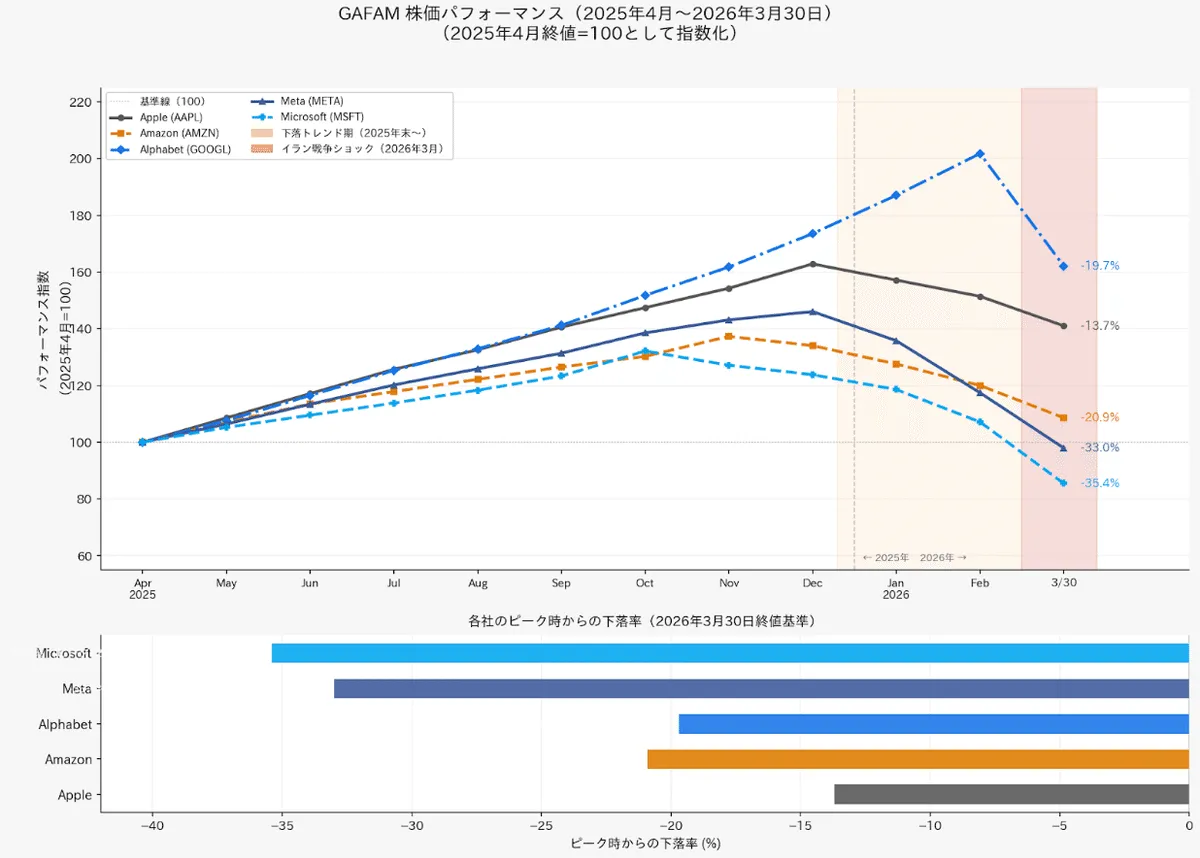
GAFAM share price performance (indexed to April 2025 = 100) and each company’s decline from its peak. All figures in the lower panel are based on closing prices on March 30, 2026, and include estimates. Upper panel: “GAFAM share performance (April 2025 to March 30, 2026), indexed to April 2025 close = 100”; y-axis: performance index; lines for Apple (AAPL), Amazon (AMZN), Alphabet (GOOGL), Meta (META) and Microsoft (MSFT), with a dotted baseline at 100; shaded bands mark the downtrend period (from late 2025) and the Iran war shock (March 2026). Lower panel: “Each company’s decline from its peak (based on the March 30, 2026 close)”; x-axis: decline from peak (%). Labels in Japanese.
Measured from their peaks, the biggest drop is Microsoft’s at about 35% (from $555 in October 2025 to $359), followed by Meta at about 33% (from $796 in December 2025 to $534), Amazon at about 21% (from $254 in November 2025 to $201), Alphabet at about 20% (from $343 in February 2026 to $276) and Apple at about 14% (from $286 in December 2025 to $247) [15].
The trigger for the latest plunge was a combination of the war with Iran (geopolitical risk from attacks on Middle East data centers and the closure of the Strait of Hormuz) and lawsuits over social harms (social media addiction). But the downtrend itself had already begun around the end of 2025.
As inflated expectations for AI investment fade, regulatory pressure mounts and the macroeconomic outlook stays cloudy, institutional investors are shifting faster toward the energy and manufacturing sectors.
Japanese pension funds and institutional investors are also heavily weighted toward US tech stocks. If this trend continues, the point where they are forced to rethink their investment policies may be getting closer.
A US jury finds Meta and Google liable for the first time over social media addiction
On March 25, a jury in Los Angeles County Superior Court found Meta’s Instagram and Google’s YouTube to be defective products intentionally designed to make minors addicted, and ordered a total of $6 million in damages (70% from Meta, 30% from Google) [9].
It is described as one of the first major jury verdicts in the US to hold social media platforms liable as defective products in a civil case, and it will have a big impact on more than 2,000 similar pending lawsuits.
With limits on minors’ smartphone use also under debate in Japan, the verdict is drawing attention as a precedent that reopens the question of how far platform companies’ responsibility extends.
Drone strikes cause a major outage at AWS data centers in the Middle East
From March 1 to 3, drone strikes, reportedly in retaliation by Iran, hit three AWS facilities in the UAE and Bahrain, causing widespread service outages in the Middle East region (ME-CENTRAL-1) [10].
Several industries were hit, including financial institutions, payment services and ride-hailing apps. As a case of geopolitical risk physically destroying cloud infrastructure, it sent shockwaves through the whole industry.
For Japanese companies operating globally, too, it looks urgent to recheck how much they depend on the cloud in the Middle East and emerging markets, and how their redundancy is designed.
Google’s TurboQuant shakes the memory industry
On March 25, Google announced TurboQuant, a quantization algorithm that cuts the KV cache memory of LLMs to one-sixth without losing accuracy, and said it can deliver up to an 8x speedup on H100 GPUs [11].
Right after the announcement, shares of Micron, Western Digital, Samsung and SK Hynix fell, as fears spread that software efficiency gains could fundamentally change demand for high-bandwidth memory (HBM).
Japan’s semiconductor industry is not immune either. If “algorithms replacing demand” spreads through AI infrastructure, memory suppliers will be forced to rethink their medium- to long-term strategies.
Amazon and Meta carry out and plan large-scale layoffs
Following about 16,000 job cuts in January, Amazon cut more than 100 additional jobs in its robotics division in March, bringing its cumulative cuts since 2022, mainly in corporate roles, to more than 57,000 [12].
At Meta, where AI-related capital spending is expected to swell to as much as $135 billion in 2026, reports say the company is considering cutting up to 20% of its workforce (about 15,000 people). At the end of March, about 700 people were laid off across Reality Labs, the Facebook division and elsewhere [13].
The sight of GAFAM pouring huge sums into AI while cutting jobs on a massive scale puts the question back in front of Japanese companies: how do you balance digital transformation with employment?
Strong light makes the shadows deeper.
The flashier this month’s light-side news was, the more the darkness piling up behind it stood out.
The social media addiction lawsuits, the regulatory pressure, more than 57,000 layoffs: all of this had been quietly building up long before the war with Iran began.
Add the new gravity of geopolitical risk in the Middle East, and the gap between light and shadow looks wider than ever.
How deep is tonight’s darkness, and how long will it last? I’ll stay hidden quietly in my tree and keep watching.
References
[1] Apple introduces iPhone 17e (Apple Newsroom)
[2] Apple introduces the new MacBook Air with M5 (Apple Newsroom)
[3] Say hello to MacBook Neo (Apple Newsroom)
[4] OpenAI announces $110 billion funding round with backing from Amazon, Nvidia, SoftBank (CNBC)
[5] Google announces seven improvements in “Nano Banana 2” (ZDNet Japan) (in Japanese)
[6] Meta reveals four new MTIA chips built for AI inference (Tom’s Hardware)
[7] Google wraps up $32B acquisition of cloud cybersecurity startup Wiz (TechCrunch)
[8] Meta acquired Moltbook, the AI agent social network (TechCrunch)
[9] Jury finds Meta and Google negligent in social media harms trial (NPR)
[10] Amazon says drone strikes damaged 3 facilities in UAE and Bahrain (CNBC)
[11] Google unveils TurboQuant, a new AI memory compression algorithm (TechCrunch)
[12] Amazon lays off robotics staff in latest cuts (GeekWire)
[13] Meta cutting several hundred jobs across Reality Labs, Facebook and other departments (CNBC)
[14] The Iran war turned Mag 7 stocks into dip-buying bait (Fortune)
[15] Alphabet vs. Amazon: Both AI Stocks Have Been Hammered (Motley Fool)