
GAFAM NewsEssay
Can we stop with the hindsight takes? Why the AI race rarely keeps the same leader
A look back at the AI race from ChatGPT to Claude Code, the strengths and weaknesses of eight players, and why the lead keeps changing hands.
- First published in Japanese
- English edition
In the race to build AI, the service with the upper hand has changed again and again, at a dizzying pace.
Each time, someone offers a plausible explanation of why that service pulled ahead. I suspect many of you have been left wondering, “Wait, then what about everything they said last time?”
When ChatGPT took the world by storm, people praised OpenAI’s technology and Sam Altman’s leadership. When Gemini pulled ahead, the line became that Google’s overwhelming money and R&D muscle made it inevitable. And now that Claude is highly rated, the praise goes to its safety-first development philosophy and the foresight of its enterprise strategy.
I’m just an owl 🦉; I have no idea who will win in the end.
But so we don’t get pushed around by hindsight explanations as we watch this race, I’d like to look back over the history of the AI race and sort out where each company stands, with its strengths and weaknesses, using numbers and quotes along the way.
How the AI race unfolded, starting with ChatGPT
The hindsight explanations I mentioned above exist for one reason: the AI race moves abnormally fast.
So let’s first recap its dramatic shifts, check where the market and the players stand today, and get ourselves ready not to panic whatever happens next.
November 2022: ChatGPT arrives and stuns the world with humanlike conversation
On November 30, 2022, OpenAI released ChatGPT. Its “humanness,” on a different level from the chatbots of the time, stunned the world, and it passed 100 million monthly active users within two months of launch. [1]
CEO Sam Altman’s decision to open AI up to the general public set the framework for the AI race that followed. [2]
2023: Google struggles, Microsoft moves first, Anthropic rises
The shock of ChatGPT hit Google especially hard.
Google was the company that had published the Transformer architecture in 2017, the foundation of modern LLMs, and yet OpenAI beat it to a consumer chat AI.
In February 2023, news reports pointed out a wrong answer from Bard (later folded into Gemini) in a promotional video. Alphabet shares fell 7.7%, wiping roughly $100 billion off its market value. [3] Within the industry, you often heard Google criticized as a case of “the big-company dilemma” or “a slow-moving giant.”
Microsoft, meanwhile, moved fast, building its cumulative investment in OpenAI up to $13.6 billion. The verdict on that call came quickly: Microsoft stock rose about 57% in 2023. [4]
That same year, Anthropic released its first-generation Claude and set off on its own path with a safety-first development philosophy.
2024: Expanding into multimodal and a faster model race
In 2024, competition widened from “text only” to “multimodal,” handling images and audio as well.
In May, GPT-4o showed off real-time processing of voice and images, Anthropic launched Claude 3, and Meta released Llama 3.
The performance gaps between companies’ models were starting to narrow, and this was the year the axis of competition began to shift from “what it can do” to “who it reaches, and how.”
2025: The DeepSeek shock, the Ghibli craze, and Google’s comeback
In early 2025, China’s DeepSeek-R1 sent shockwaves through the industry.
Its training cost was reported at just $294,000 (while a comparable OpenAI model reportedly cost over $100 million), overturning conventional wisdom about what AI development costs. [6] Suspicions of “distillation” later surfaced, and in February 2026 OpenAI strongly criticized DeepSeek in a document submitted to Congress. [7]
In March, GPT-4o’s “Ghibli-style image generation” spread explosively on social media, setting off a worldwide debate over copyright. [5]
The second half of the year was marked by Google’s comeback.
There was the release of Gemini 2.5, the surging reputation of NotebookLM, and the image generation model “Nano Banana,” released in August, which logged more than 200 million image edits within a few weeks. It drew attention as Google’s answer to GPT-4o’s Ghibli craze. [8]
Gemini’s share of traffic jumped from 5.4% to 18.2%, and reports said a “Code Red” level of alarm was shared inside OpenAI. It was the first year the front-runner was seriously cornered. [9]
Now, in 2026: Claude Code’s winning streak, and Meta’s change of direction and big investments
As of March 2026, the big story is the rise of Claude Code.
Unlike earlier AI tools that complete code, it is an agent-style tool you can hand an entire task to, and it is spreading fast in the developer community. Adoption in development environments such as VS Code has grown sharply in a short time, and it looks to have entered a phase of rapid spread much like ChatGPT’s debut. [11]
In the AI agent field, OpenClaw, built single-handedly by an Austrian developer, also drew attention as an “autonomous agent that can run 24 hours a day,” and both Meta and OpenAI moved to acquire it. In the end, its creator, Peter Steinberger, joined OpenAI. [23]
Meta has scaled back its metaverse business, the very thing its name change once symbolized, while continuing to pour big money into AI. It acquired Moltbook, which runs a social network exclusively for AI agents. It also invested $14.3 billion in Scale AI for a 49% stake, signaling its view that the key to the AI race lies not only in “model performance” but also in “the quality and quantity of training data.” [12]
Each company’s strengths and weaknesses
Below, I sort out eight companies and services, OpenAI, Google, Anthropic, Microsoft, Apple, Amazon, Meta and xAI, from five angles: (1) user base, (2) technology, (3) revenue structure, (4) distribution channels and (5) room to grow.
◎ OpenAI (ChatGPT): The front-runner’s real strength and its structural problems
Strengths
OpenAI’s biggest assets are its overwhelming brand power and first-mover advantage.
It has more than 800 million weekly active users and keeps the top spot in Apple’s annual US App Store download rankings. [1]
Financially, it booked $4.3 billion in revenue in the first half of 2025, and its annual run rate is estimated at over $13 billion.
Another big strength is probably CEO Sam Altman himself.
His firm conviction that AGI (artificial general intelligence) can be achieved, and his ability to keep persuading investors, governments and partners around the world of it, are hard to replace. The $13.6 billion strategic investment from Microsoft can also be called the fruit of Altman’s negotiating skill. [2]
Weaknesses
The biggest problem is chronic losses.
Operating costs eat up about 70% of revenue, and HSBC forecasts that it will still be losing money in 2030.
Fewer than 5% of all users pay, and in major European markets the number of paid subscribers has plateaued since May 2025.
In fall 2024, CTO Mira Murati left, and co-founder Ilya Sutskever had also departed. This string of senior exits leaves questions about the organization’s stability. [13]
◎ Microsoft (Copilot): The strongest foundation for enterprise AI
Strengths
90% of Fortune 500 companies have adopted Microsoft 365 Copilot, a level of penetration in the enterprise market no rival comes close to.
Azure’s AI-related sales grew 40% year over year as of Q1 of fiscal 2026, and revenue reached $78 billion. [14]
Its $13.6 billion stake in OpenAI gives it priority access to cutting-edge models, and the way it has woven AI deep into the workplace foundations of Office, Teams and GitHub is a strength competitors can’t quickly copy.
Weaknesses
Only about 2% of Office 365 users use Copilot day to day, and there are reports that many companies doubt they’re getting $30 a month worth of value. [15]
And now that OpenAI has started selling ChatGPT Enterprise directly, Microsoft finds itself competing for the same customers with the company it invested $13.6 billion in.
◎ Google (Gemini): A giant with both research power and reach
Strengths
Google’s strength is that it has all three: research, reach and data.
Its subsidiary DeepMind brings together some of the world’s top researchers, Nobel laureates among them, and has produced results others can’t easily match, such as protein structure prediction (AlphaFold) and quantum computing (the Willow chip). [16]
The scale at which its research reaches real users is just as overwhelming.
Google Search (about 90% of the global market), Google Maps, YouTube (more than 2 billion monthly viewers) and Android (about 72% of the smartphone OS market): these giant services are channels for delivering AI, and at the same time a precious source of AI training material, generating enormous amounts of user behavior data every day.
Gemini passed 750 million monthly active users at the end of 2025, growing more than 115% in a year. [17]
Weaknesses
The caution a big organization brings to release decisions sometimes doesn’t mesh with the speed of the AI race.
The fact that Google created the Transformer architecture and still got beaten to a consumer chat AI by OpenAI says a lot about how heavy the internal coordination costs of a large company are.
◎ Anthropic (Claude / Claude Code): A safety philosophy and the king of coding
Strengths
Anthropic puts Constitutional AI (a safety mechanism in which the model evaluates and corrects its own responses) at the core of its development, and has earned deep trust from risk-sensitive industries such as finance, healthcare, law and government.
Its enterprise market share is 29%, ahead of OpenAI’s 25%, and 80% of its revenue comes from business customers. [11]
In coding, it leads the industry with a SWE-bench Verified score of 77.2%, and its standing in the developer community is rock solid.
On the funding side, Amazon has invested a total of $8 billion and Google more than $3 billion. While rivals spread their capital across image and video generation, Anthropic has kept its lead in text and code AI by deliberately concentrating there.
Weaknesses
Its consumer user base is just under 20 million a month, and its share of the AI market is only about 2%. [24]
With no image or video generation service, its appeal in the consumer market is limited.
That said, all of this follows from Anthropic’s deliberate strategy of putting business first and concentrating on text. Its strengths and weaknesses are two sides of the same coin.
◎ Apple (Apple Intelligence): A latecomer with the strongest connection to users
Strengths
Apple’s biggest asset, without question, is its base of more than 2.3 billion devices.
These are the physical touchpoints people handle for the longest time every day, and as a channel for delivering AI, their scale rivals even Google’s.
Many competitors, including OpenAI and Anthropic, rely on processing AI in the cloud and sending user data to their servers. Apple, by contrast, has invested strategically in “on-device inference,” completing AI processing on the device itself with chips it designs in-house.
It’s an approach only Apple can take, since it handles everything from device design to manufacturing, and it delivers privacy protection, no network lag and offline operation all at once.
That’s a differentiator a pure software company can’t copy.
Weaknesses
Apple is clearly a latecomer in developing its own core LLM.
The major Siri overhaul keeps getting delayed, and in November 2025 it was reported that Apple would use Google’s Gemini for some Siri features. It looks as if Apple has had to lean on its biggest rival. [18]
There’s also a contradiction: because of its company policy of rigorously protecting user privacy, it can’t make full use of its wealth of user data for AI training.
◎ Amazon (AWS Bedrock): The biggest infrastructure player’s turn to AI
Strengths
AWS is the biggest infrastructure provider, with a 31% share of the global cloud market. [19]
The core of its AI services is Amazon Bedrock. Besides Amazon’s own Nova family of models, it lets companies use multiple outside models, including Claude, Llama and Mistral, from a single platform. Enterprise customers like this setup, a kind of “multi-brand counter for AI.”
Its cumulative $8 billion investment in Anthropic puts it in a position to offer Claude on Bedrock on preferential terms, and its 2025 capital spending (capex) topped $100 billion.
Weaknesses
Many assessments find its in-house Amazon Nova falls short of Claude and Gemini in coding performance and reasoning, so Amazon doesn’t have a flagship model that leads the competition.
As a result, Bedrock remains structurally dependent on other companies’ models. Bedrock and Amazon Q also trail Azure OpenAI in brand awareness and adoption, and Amazon’s AI products haven’t caught on to the degree its cloud share would suggest.
In 2025 it cut more than 14,000 jobs, and being in the middle of a reorganization is also a short-term risk. [20]
◎ Meta (Llama): The strength of an open-source strategy, and the problem of a late start
Strengths
Meta follows an open-source strategy, releasing its Llama series for free.
Because researchers and developers around the world can freely improve and use Meta’s models without owning their own infrastructure, AI services built on Meta’s models spread naturally.
While others stack up API revenue, Meta builds influence as a “common platform for AI.” That’s its distinctive strategy.
Its $14.3 billion investment in Scale AI can also be seen as building the training-data foundation that supports this open-source strategy. [12]
Meta is also the only GAFAM company whose founder is still leading from the front line. It has a proven track record and a reputation for correcting course quickly, and when its strategy clicks, its ability to charge ahead shouldn’t be underestimated.
Weaknesses
Around 2021 to 2022, just as the AI race was heating up, Meta poured huge sums into the metaverse (Reality Labs’ annual losses ran on the order of $10 billion), and its full-scale entry into AI came late. [21]
It is trying to catch up, but “Avocado,” the model expected to be its next-generation flagship, fell short of rival models in internal testing, and its release has slipped from the original schedule to May 2026 or later.
The suspicion that it used a separate version of Llama 4, one better suited to benchmark comparisons, also damaged the credibility of its brand. [21]
◎ xAI (Grok): An upstart whose weapon is boldness
Strengths
Grok can tap directly into real-time data from X (formerly Twitter), a unique strength that lets it instantly pick up the latest news and the mood of the market.
In coding, too, one study found it performed on par with or better than comparable models such as Gemini, ChatGPT and Claude. [22]
But its most obvious strength may be its boldness.
While Google and the other big players are cautious about content policy, Grok takes a permissive stance on adult content and politically edgy remarks, offering a new option to people who are critical of AI regulation.
Many will remember the big controversy after X introduced a feature that let users edit photos posted on X with Grok: the platform was flooded with posts that put other people in swimsuits. [25] X then reversed course and imposed restrictions, but in terms of generating buzz, it worked.
Startup-like decision speed and a willingness to brush off regulation are a differentiator its competitors would find hard to match.
Weaknesses
It depends heavily on the X platform, so changes in X’s content policy or swings in its ad market feed straight into Grok’s brand.
Its hallucination rate (generating information that isn’t factual) is also somewhat higher than its rivals’, and the fact that xAI itself announced it had cut this by two-thirds in Grok 4.1 shows how big the problem is. [22]
Being only two and a half years old is a clear handicap when it comes to the track record enterprise customers look for.
Where each company stands, by the numbers
Below are the shift in share of US mobile app daily active users from January 2025 to January 2026 (left) and a comparison on the coding benchmark SWE-bench Verified (right).
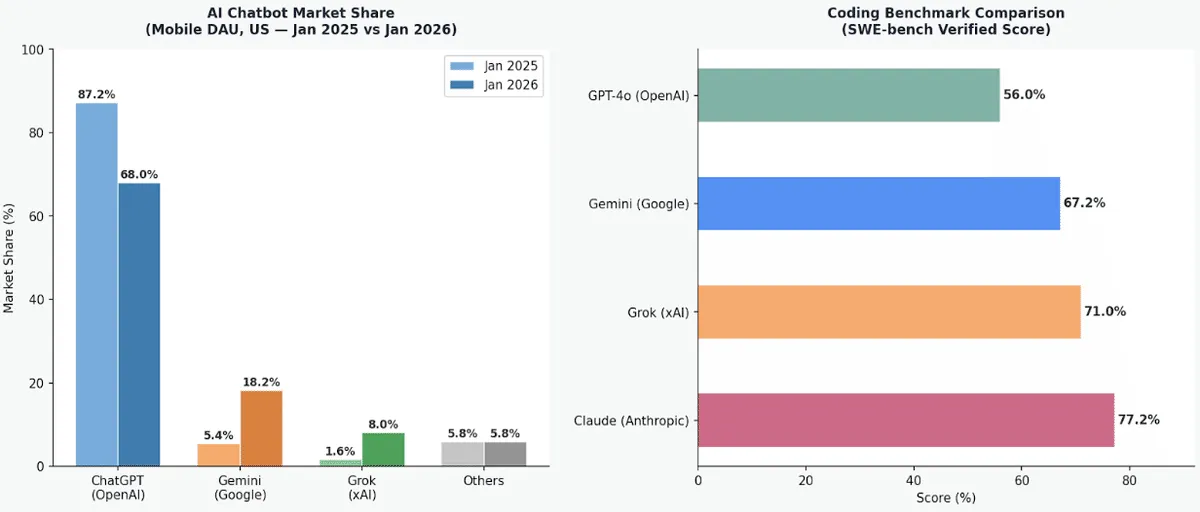 Figure: Shift in AI chatbot market share (left) and coding benchmark comparison (right). Sources: Similarweb [10] and companies’ published data.
ChatGPT still holds first place, but the rapid rise of Gemini and Grok is clear at a glance.
In coding, Anthropic, far behind in user numbers, posts the highest score. It shows that in today’s competition, scale and technical strength don’t necessarily go hand in hand.
The nature of the AI race: a reversal is always possible
From here, I’d like to add my own owlish interpretation to everything we’ve looked at and think about the nature of the AI race.
As I said at the start, I have no idea who the ultimate winner will be.
But what strikes me now is that the frequent changes of leader may themselves be the structure, the very nature, of this race.
Think of it as a long-distance race in which the lead keeps changing hands.
The AI race is often described as an investment game of chicken. But in reality, isn’t it structured so that a reversal can happen as long as you keep investing?
In the old fight over internet portals, there were clear differences in strategy and technology, like Google’s crawler-based search versus Yahoo’s directory-style service.
In today’s AI race, though, no such decisive difference has emerged yet, and many players seem to be fighting in the same ring.
Because it’s the same ring, poaching talent from one another is rampant, and as a result knowledge and technology tend to get shared across the board. That is probably part of what makes it hard for any one company to pull far ahead.
There’s also so much technical headroom on the way to AGI and beyond that a modest lag can be made up in a relatively short time.
And, as DeepSeek and others have shown, being first isn’t necessarily an advantage in itself. A pattern in which the leaders act as pacemakers and latecomers catch up efficiently, a sort of “late rock-paper-scissors” (throwing your hand only after seeing your opponent’s), can very well happen.
On top of that, this market makes it hard to lock users in with powerful network effects, the way Microsoft once did with Windows and Office. Users switch easily to whatever is smarter and easier to use, and it’s common to use several services side by side.
Even Apple, Amazon and Meta, which seem to be lagging, are probably biding their time, watching for a chance to strike back.
Because the structure makes it easy for the lead to change hands, if they can put their own strengths to work, the situation could flip in an instant.
And this contest is playing out as an extension of what’s already on the table.
That’s why hindsight explanations rarely bring a new perspective. How we read “now” may matter more.
That, at least, is how it looks from my branch. 🦉
What comes next
When, and from where, will the next big move come?
Google may be preparing a surprise announcement for Google I/O in May, like Gemini 2.5 last year.
Apple has WWDC coming up in June, and the focus will be on how far the Siri overhaul has come in light of its Gemini partnership.
OpenAI, for its part, has a history of countering rivals’ big announcements. Its moves around Google I/O will likely draw particular attention. [9]
Amazon keeps piling up infrastructure investment of more than $100 billion, and its partnership with Anthropic is steadily starting to show results.
Meta’s Avocado is slated for release in May 2026 or later, and how far it can catch up with rivals will be the test for now.
Among GAFAM, Amazon and Meta have also carried out large-scale layoffs and are steering hard toward AI. It may take some time before results show, but I’ll keep watching what they do.
As for xAI, Elon Musk’s unpredictable decisions continue to act as a wild card. With outlandish product announcements or big deals, it has the potential to redraw the competitive map in one stroke.
As an owl 🦉, I’m a stealth hunter: I quietly size up my prey, close in, and take it in a single strike.
In the AI race, each company fights with its own strengths as its weapon, watching for openings in the others. I want to enjoy it from a little distance and keep watching quietly.
References
[1] ChatGPT advanced AI, but OpenAI faces hurdles in keeping lead (TechTarget)
[2] A brief history of Sam Altman’s hype (MIT Technology Review)
[3] Google shares lose $100 billion after Bard AI chatbot gives wrong answer in ad (CNN Business)
[4] Microsoft’s AI Bet Keeps Paying Off Across Cloud, Copilot and Code (PYMNTS)
[5] OpenAI’s viral Studio Ghibli moment highlights AI copyright concerns (TechCrunch)
[7] OpenAI accuses DeepSeek of malpractice ahead of AI launch (Rest of World)
[8] Google started the year behind in the AI race. It ended 2025 on top. (Bloomberg via Yahoo Finance)
[9] Inside OpenAI’s fragile lead in the AI race, and the 8-week ‘code red’ (Fortune)
[10] AI Chatbot Market Share 2026: ChatGPT Drops to 68% as Gemini Surges (Vertu / Similarweb)
[11] Anthropic’s Claude Code is having its ‘ChatGPT’ moment (Uncover Alpha)
[12] Scale AI’s Alexandr Wang confirms departure for Meta as part of $14.3 billion deal (CNBC)
[13] OpenAI SWOT Analysis (2026) (Deep Research Global)
[14] Microsoft Q1 2026: Deepens OpenAI partnership and sustains growth (The Fifth Person)
[15] Microsoft faces uphill climb to win in AI chatbots with Copilot (CNBC)
[16] Google’s year in review: 8 areas with research breakthroughs in 2025 (Google Blog)
[17] ChatGPT vs Claude vs Gemini (Revenue, Users & Funding) (AI Funding Tracker)
[18] Apple picks Google’s Gemini to run AI-powered Siri features (CNBC)
[19] Cloud Market Share Trends: Big Three Together Hold 63% (Synergy Research Group)
[20] Amazon cuts 14K jobs in AI-fueled reorganization (CIO Dive)
[21] Meta Delays Avocado AI Model After Failing to Match Rivals (WinBuzzer)
[22] Grok 4: Is It Really the World’s Most Powerful AI? An Honest B2B Analysis (BayTech Consulting)
[23] OpenClaw creator Peter Steinberger joining OpenAI, Altman says (CNBC)
[24] Claude AI Stats 2026 – Market Shares, Total Users, and More (Fatjoe)